Multi-Step Attack Path Discovery in AI-Augmented Penetration Testing
AI can chain small flaws into breaches, but humans must sign off.
AI-augmented penetration testing earns its name through multi-step attack path discovery. Its job is to link small weaknesses into a proven route to a serious breach. AI can find and test those connections, but qualified human reviewers must judge their business impact and sign off on the evidence.
Why chaining low-severity findings into breach paths is the real test of a pen test
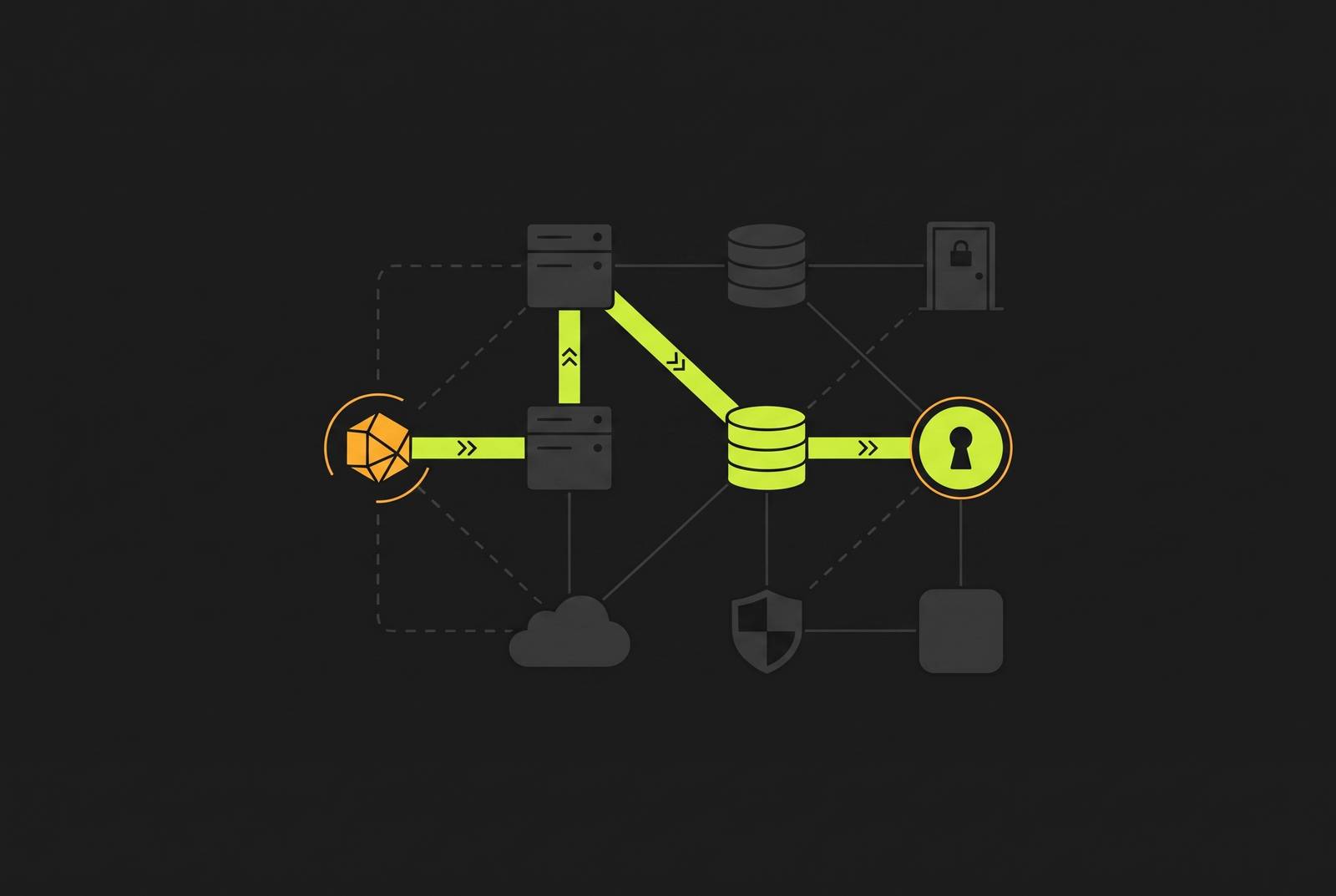
An insecure direct object reference, or IDOR, on one endpoint feeds a privilege escalation on another, which then enables data exfiltration. None of the findings in this example rates as critical alone. Together, they form a catastrophic breach path. The danger lies both in what an attacker can do with each weakness in isolation and in what it unlocks next.
That is where siloed testing falls short. It evaluates each finding against its own CVSS score, then moves on without asking how the result changes the attacker’s options. A point-in-time report can therefore get each finding right while giving a false picture of how secure the system is. The engineering team sees low-to-medium risks and concludes that the product is in reasonable shape, even though the route to a serious breach remains undiscovered.
Finding the first weakness is only the beginning. A useful assessment establishes how an attacker could cross from one endpoint, privilege level, or asset to the next, and what becomes reachable at the end. That changes the unit of analysis from a vulnerable component to an attack path.
How compliance-driven testing entrenches the siloed approach
When teams buy testing to meet compliance rules, they often reward just enough evidence to pass over a serious attempt to reach a business-critical objective. Teams scope the mandated systems and buy a report that satisfies the immediate request. The scope becomes the security boundary by default. Yet the assets that would cause the most harm if compromised may form a chain that reaches beyond the systems tested.
The missing deliverable is a documented Path to Compromise. It starts at a specific entry point, moves through specific findings in a specific order, and reaches an objective with a clear business consequence. Most compliance engagements never produce that narrative.
The frameworks themselves are not the source of this gap. A properly run PCI DSS or ISO 27001 engagement involves manual exploitation and creative chaining, just as a traditional engagement does. The pressure comes from scoping and delivery. When the purchase is defined around producing acceptable paperwork, there is little room for the work needed to discover and prove a longer attack path.
What agentic AI actually does differently from a vulnerability scanner
A traditional scanner checks inputs against known vulnerability signatures, then reports the results. An agentic system instead has a goal to work toward. It reasons about the available moves, plans a sequence, attempts exploitation, and adapts to what happens. Each finding becomes a node in a graph of possible next steps.
Building that graph takes more than probing exposed endpoints. The system correlates source code, cloud configurations, API schemas, authentication flows, and product documentation. It can ingest OpenAPI/Swagger specs, inspect traffic, identify shadow APIs and zombie API versions, and map privilege levels before exploitation begins. Whitebox access supplies the internal view that this requires. With Blackbox testing, parts of the attack surface stay out of view.
The requests also differ from generic fuzzing payloads. An agentic system learns the data format an endpoint expects and builds requests that look legitimate to the server, so it can reach weaknesses that generic inputs may miss. Multi-agent architectures divide this work among recon, exploit, privilege escalation, and reporting agents.
Speed alone does not prove any of this. Some practitioners report finding 30–40% more vulnerabilities in the same time window with AI-assisted testing, but those anecdotal accounts fall short of a formal 2026 analysis. The stronger buying criterion is whether the system can explain what one finding enables next and validate the resulting sequence.
Where AI-generated attack chains still fall short of human adversarial reasoning
A system may find combinations that a person would miss at volume without understanding which assets are most valuable or what an attacker would realistically want. That distinction limits what exploit validation can prove. A traversable path is not automatically the most important path.
Business logic exposes the gap most clearly. To assess discount code abuse, role boundary violations in multi-tenant SaaS, and session handling across OAuth grant flows, testers need to know what the application is supposed to allow. The same need for context applies to a payment flow bypass that generates fraudulent refunds.
Human creativity also remains central to finding a standard user’s route to admin through three seemingly unrelated misconfigurations, or a cloud IAM policy that exposes every S3 bucket to a compromised Lambda function. But if AI chains findings and validates exploits, why does a human still need to review them? Validation proves that the route can be followed. It does not establish the actual data at risk, the correctness of the claimed impact, or the realism of the attacker’s objective.
Those judgments require expertise and accountability beyond automated execution. AI raises the floor of automated testing and frees people to concentrate on creative adversarial reasoning.
Why human expert review is non-negotiable at the point of sign-off
A report presented to an auditor, enterprise customer, or board implies that a qualified person has judged its findings real and correctly scoped. A generated chain cannot supply that assurance by itself. The reviewer must connect the technical evidence to a business objective and confirm that the claimed outcome follows. That is what turns an AI-generated route into a credible Path to Compromise.
The review has several distinct jobs to do. It establishes what data is reachable, whose data it is, and under which access conditions. It tells a real business logic flaw apart from a configuration state that the application is meant to allow. It also decides whether a finding discovered on day three represents an active risk that requires immediate communication before the final report.
A professionally certified reviewer staking professional judgment on those conclusions provides a different form of assurance from the system that generated them. Auditors, procurement teams, and investors need to know who stands behind the evidence. A report full of “potential” or “possible” vulnerabilities without exploitation confirmation does not demonstrate that a human has completed that review.
How the full AI-augmented workflow runs from asset discovery through validated chain
A rigorous engagement begins with asset discovery, before active testing. AI ingests repositories, cloud configurations, API schemas, and product documentation to map public, private, and shadow endpoints. It identifies authentication mechanisms, including JWT, OAuth, and API keys, then maps privilege levels and trust boundaries. This map supplies the starting conditions for the attack hypotheses. It is not merely an inventory attached to the report.
AI builds an ordered graph of combinations that could produce a critical outcome and ranks them by potential impact. A human tester then checks that ranking against what matters to the business. The assets worth the most and the goals an attacker could realistically pursue guide which paths get attention first.
Active exploitation puts those hypotheses to the test before they can be reported as findings. AI executes sequences, adapts to the results, and generates proof-of-concept exploits for confirmed steps. Every finding entering the report has a working exploit behind it. Critical discoveries are shared right away, so the response to an active risk does not have to wait for the report.
A certified reviewer then evaluates every finding and authors the Path to Compromise narrative. The report and letter of attestation follow that review, with human sign-off providing the accountability needed for audit evidence under SOC 2, HIPAA, and ISO 27001. The engagement does not end with those documents. Remediated findings are retested on demand rather than sold as a separate engagement, while continuous pull-request scanning catches regressions when new code is pushed.
What the common vulnerability classes look like inside a multi-step chain
SQL injection, classified as CWE-89, can provide the data-extraction step after privilege escalation opens access to a vulnerable query. Unsanitized user input lets an attacker interfere with database queries, so its role in the chain depends on what earlier steps make reachable. The fix is parameterized queries and safe query builders.
Cross-Site Scripting, or XSS, offers different opportunities through reflected, stored, and client-side variants. Stored XSS in a persistent field can let an attacker carry out credential harvesting, then move on to account takeover and lateral movement. Context-aware output encoding and a strict Content Security Policy address this link.
Server-Side Request Forgery, or SSRF, classified as CWE-918, bridges externally reachable input and internal infrastructure. In cloud environments, a route to an AWS/GCP/Azure metadata endpoint can expose instance credentials that enable further access. The fixes include destination allowlisting, IMDSv2 enforcement where applicable, and egress firewalls.
Insecure deserialization, classified as CWE-502, can turn an authentication bypass into remote code execution when an attacker’s payload executes code as the application deserializes it. The earlier bypass opens the door to this step. The fix is to avoid deserializing untrusted data and use safe serialization formats.
Hardcoded secrets can be the entry point itself. A leaked API key or cloud credential committed to a repository may look like a modest finding while unlocking a critical breach path. Secrets detection addresses this repository-level gap. Whitebox access lets the assessment consider these credentials together with the code and configurations that determine what they can reach.
These classes do not need to be catastrophic alone. Their importance changes with their position in the chain.
What to ask and what to watch for when evaluating an AI-augmented pen test provider
For a buyer, the evaluation should begin with who performs the work. What are the testers’ names, roles, and certifications, and will subcontractors be used? Sales team biographies do not answer that question. The same scrutiny belongs on the tools, including what data the AI receives, whether it gets source code, cloud configurations, and documentation, and who approves its actions.
The deliverable needs equally direct questions. Does the engagement produce a documented Path to Compromise or only a list of findings? Is every reported vulnerability proven with a working exploit? What happens if a critical issue appears on day three, and is retesting included?
A fixed low price, a 24-hour turnaround, and no scoping call are together enough reason to walk away. Per-IP or per-page pricing is another warning because genuine manual and AI-augmented testing does not scale linearly per IP. Sample reports also expose weak delivery through unsupported “possible” findings, generic advice such as “apply vendor patches,” missing attack chains, and formatting that matches scanner output templates.
Without a named, qualified human at sign-off, the report lacks the assurance required of evidence for SOC 2, ISO 27001, or HIPAA. Findings delivered only at the end are another warning. A critical vulnerability held for two weeks is a liability.
The affirmative standard is concrete and demanding. Thorough AI-augmented testing has whitebox access, proven exploits, a certified human who reviews every finding, and a documented Path to Compromise. It includes on-demand retesting, continuous pull-request scanning, and a direct collaboration channel with the testing team. The buyer receives evidence of how a breach could unfold, with a qualified person accountable for the conclusion.