Second-Order SQL Injection in Stored Data Pipelines
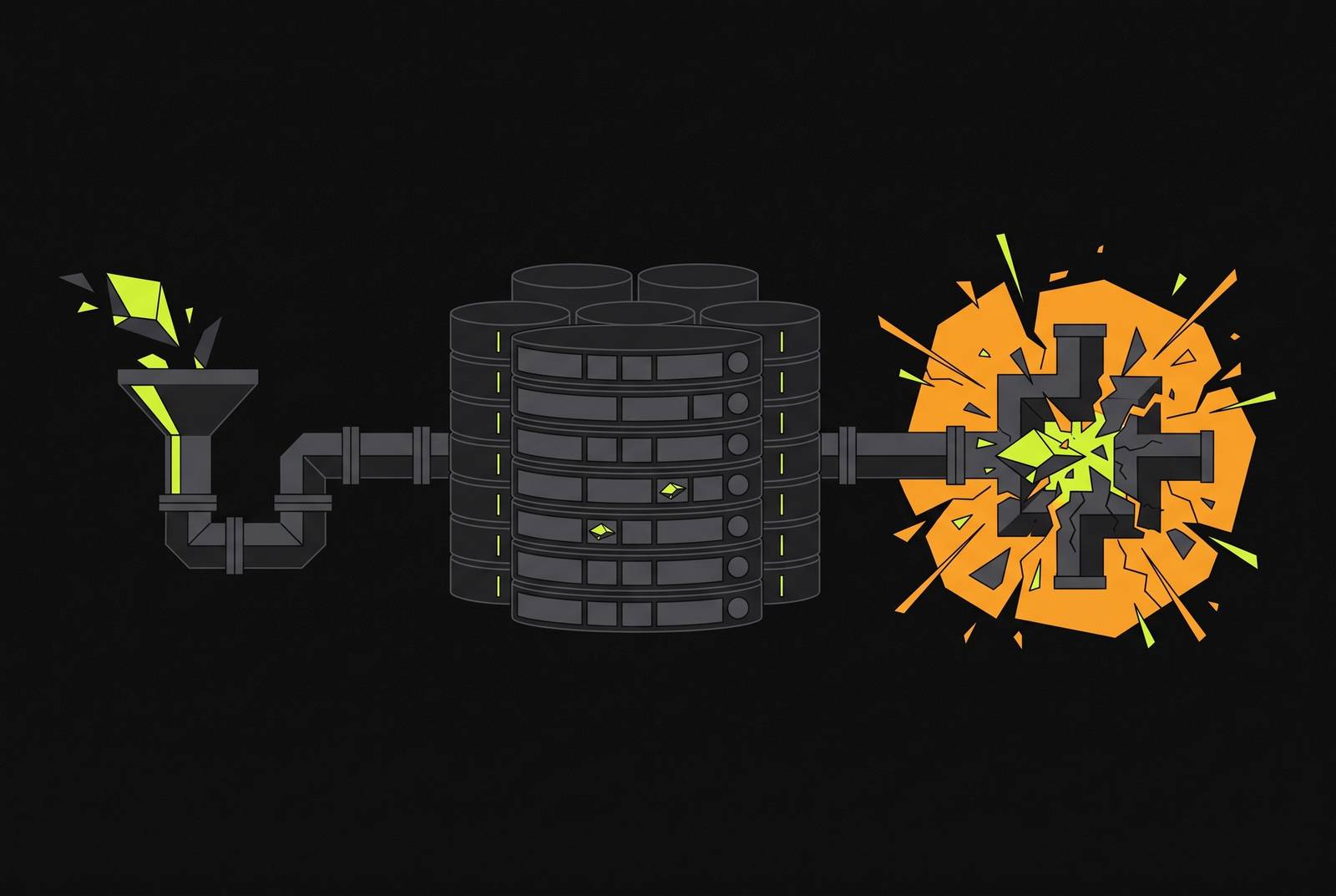
Second-order SQL injection defeats automated scanners for a structural reason, not because the technique is exotic or new. The attack splits across two separate operations, and scanners only ever watch one of them at a time.
A dynamic application security testing tool works by injection and observation: it sends a payload into a field, then watches what comes back. An error message, a timing delay, a change in the page, any of those counts as a signal. With second-order injection, the signal that a scanner relies on never appears at the moment of injection. The payload gets stored cleanly, often through a properly parameterized insert, and the scanner records a clean result and moves to the next field. Nothing about the registration form, the profile update, or the support ticket submission looks wrong, because nothing is wrong yet.
The exploit only fires later, when a completely different part of the system reads that stored value and does something unsafe with it. That might be a reporting dashboard, a nightly batch job, or a background service that nobody on the scanning tool's checklist ever pointed it at. A scanner has no model for that connection. It does not know that the display name a user submitted on one endpoint will get pulled into a raw query on another endpoint, run by a different part of the codebase, possibly maintained by a different team, hours or days later.
The payload travels through what looks like a trusted path. It gets sanitized on the way in, stored safely, then retrieved by code that assumes anything coming out of the company's own database must already be clean. That assumption is where the gap lives, and no scan of the input endpoint can see it, because the vulnerability doesn't live at the input endpoint. A clean DAST scan of the registration form says nothing about the risk sitting in the admin panel, the export job, or the reporting layer that later reads the exact same field.
How the two-stage mechanism works
The vulnerability is a flaw in how the retrieved value gets reused, not in how the input was stored.
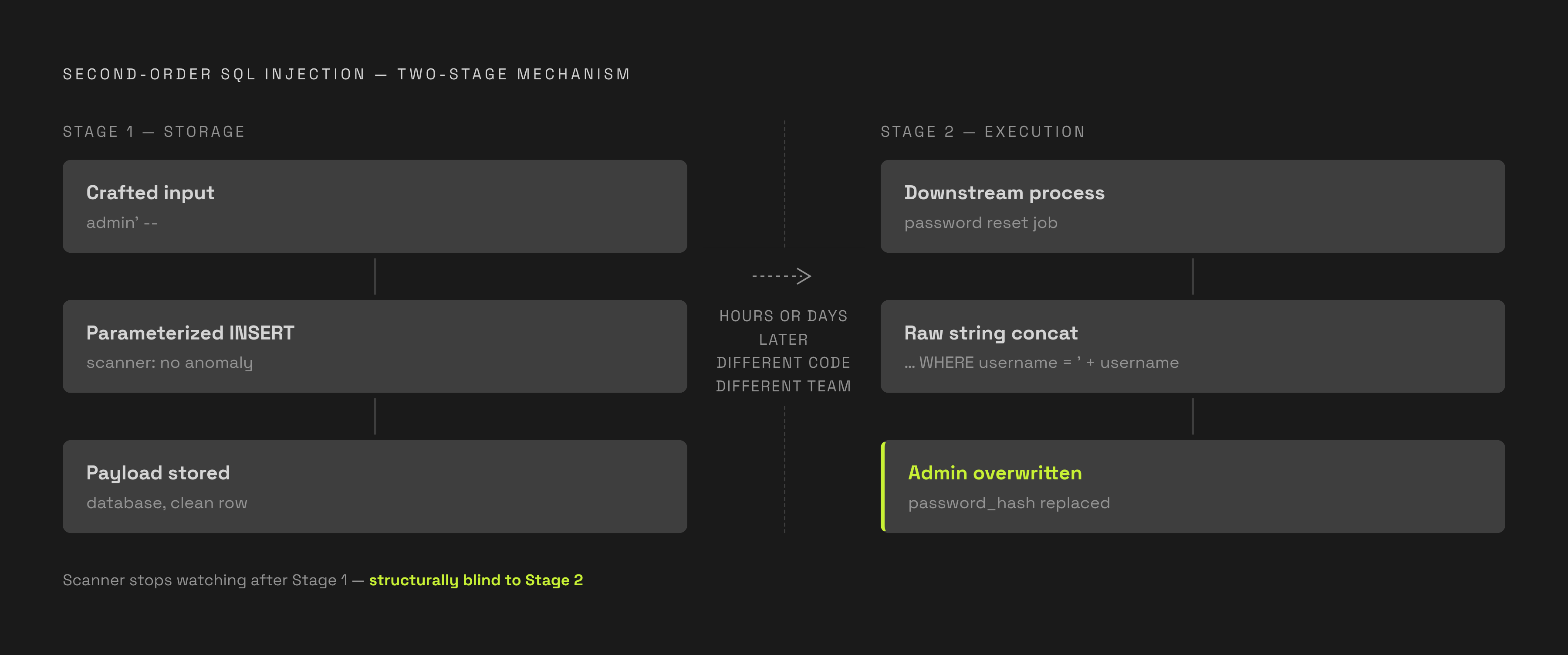
Picture the mechanism in two stages. Stage 1 is storage: user-controlled input arrives, gets parameterized correctly on insert, and lands in the database without incident. No injection happens here, which is what makes the whole pattern so hard to catch. Stage 1 looks completely clean because it is completely clean. A code reviewer checking the insert statement sees a parameterized query and moves on.
Stage 2 is where the actual vulnerability lives. Later, a separate piece of code reads that stored value back out and concatenates it directly into a new SQL string, operating on the assumption that anything pulled from the company's own database must already be safe. That assumption is false. A database doesn't sanitize data on the way out. It returns what was written to it, including any payload an attacker deliberately crafted to survive storage and detonate on retrieval.
Consider a password reset flow. The system retrieves a username and concatenates it into an update statement: UPDATE users SET password_hash = %s WHERE username = ' + username + '. If an attacker has previously set their username to something like admin' --, the constructed query becomes UPDATE users SET password_hash = '<new_hash>' WHERE username = 'admin' --'. The double dash comments out everything after it, dropping the closing quote, and the WHERE clause now resolves cleanly to the admin account. The attacker's password reset request overwrites the administrator's password hash.
The same logic applies to a reporting query. A user who sets their display name to %' UNION SELECT username, password FROM users-- has planted a payload that does nothing at signup. It sits quietly in the database until an admin reporting job pulls display names into a query and runs it, at which point the UNION SELECT executes and starts pulling usernames and passwords out of the users table. The injection didn't happen when the name was typed. It happened when a completely unrelated process read that name back and trusted it.
Where stored data pipelines create the most exposure
Second-order injection concentrates in architectures that separate data ingestion from data consumption. The wider that separation, the more room there is for the trust assumption to form, unexamined, somewhere in the middle.
Several patterns recur across stored data pipelines. ETL pipelines and batch processors that read stored records and build downstream queries are a common exposure point, since the people who wrote the batch job rarely wrote the endpoint that originally accepted the data. Admin reporting dashboards carry similar risk, especially when they pull user-controlled fields such as display names, usernames, or addresses into raw LIKE clauses, GROUP BY statements, or export queries. Background jobs that process records written by a different service, microservices that consume data written upstream by a team that never saw the original request, and support ticket systems, feedback forms, chat logs, or audit logs reused later in search or reporting all carry the same structural risk. Authentication flows, including password reset, profile updates, and session management, are especially dangerous because they retrieve a stored identifier and plug it straight back into a query, exactly as shown in the password reset example above.
Growth-stage SaaS companies face this risk acutely. Admin tooling and internal reporting tend to get built fast and late, often with raw SQL queries, long after the customer-facing API already went through a security review and got wrapped in an ORM. The public-facing surface looks solid. The internal tooling built six months later by a different engineer, under deadline pressure, to answer one executive's question about active users, often isn't held to the same standard.
ORMs create a false sense of safety that compounds the problem. Most object-relational mapping tools parameterize queries automatically when developers use their standard query builder, which is genuinely effective. But nearly every ORM also exposes raw-SQL escape hatches: .raw(), .extra(), @Query(nativeQuery=true), and equivalents in other frameworks. Developers reach for these when the query builder can't express something they need, and in doing so, they step outside the protection the ORM provides. The danger is that teams assume the ORM protects every code path in the application, when it only protects the paths that actually route through its query builder. A field stored safely through the ORM on one endpoint can still get pulled into a raw, unparameterized query on another endpoint, written by someone who never thought to check.
The impact spectrum once a stored payload fires
Once a second-order payload finally executes, it does the same damage a first-order injection would. The delay between planting and firing doesn't limit the outcome, and in some cases it makes the outcome worse, because the payload fires inside code that runs with more trust and more privilege than the original input endpoint ever had.
The impact progression tracks ordinary SQL injection closely. Authentication bypass is one outcome, as in the password reset example, where an attacker's crafted username overwrites the administrator's password hash. Data disclosure is another, where UNION SELECT payloads planted in a stored field get executed inside a reporting query and pull credentials or sensitive records out of tables the original user endpoint never had access to. Data modification follows the same logic: UPDATE or DELETE statements triggered by a stored payload inside a downstream batch job can alter or erase records far outside the scope of whatever form the attacker originally submitted. Privilege escalation can happen too, where a stored referral code or profile field flips an is_admin flag when a later process reads and reuses it. At the far end of the spectrum, file read and write access on the database host becomes possible, and depending on the database configuration, that can extend to remote code execution and full compromise of the host.
The common thread across all of these outcomes is that the payload sat dormant, sometimes for days, waiting for the right downstream process to read it. That waiting period means the attack occurs in a part of the system that nobody was watching for it.
Why code review and data-flow analysis are the only reliable detection methods
Finding second-order injection requires manually reconstructing the full path a value takes from every point where it gets stored to every query that later consumes it, across requests, across services, and across time. No automated scanner does this today, because the limitation is structural rather than a gap current tooling will eventually close. The vulnerability lives in the relationship between two separate code paths, not inside either one on its own, so a tool that examines one request-response cycle at a time has no way to see it.
A manual reviewer works differently. Every field that gets written to the database gets traced forward through the codebase to every query that later reads it. Each of those downstream queries gets checked individually for whether it parameterizes its inputs or concatenates them directly into a SQL string. That tracing has to follow the value across service boundaries, into background jobs, and into admin tooling, not just along the original user-facing request and response. A reviewer working this way is also positioned to catch the specific split described earlier: a field stored safely through an ORM, then read back out and reused in a raw query somewhere else in the codebase. No single-endpoint scan surfaces that split, because the two halves of it live in different files, written at different times, often by different engineers.
This kind of analysis depends on whitebox access to source code. Without the ability to read the retrieval code and see the exact shape of the downstream query, a tester is reduced to guessing which stored fields get reused later and how. Second-order injection almost never announces itself from the outside.
Tracing second-order injection in a whitebox pen test
A whitebox penetration test built to find second-order injection treats every database write as a potential source of attacker-controlled data, then audits every downstream consumer of that field for unsafe query construction.
The process starts by mapping all storage points. Every field written to persistent storage that originates from user-controlled input gets enumerated: fields written by API endpoints, by import jobs, by third-party webhooks, and by file uploads all belong on that list. From there, the test moves to tracing where each of those fields gets read back out and reused, building a map from write to read across the entire codebase.
The next step is testing the gap directly. Testers craft payloads for fields that flow into concatenated queries downstream, submit the payload through the original storage endpoint, then trigger whatever downstream operation reads and reuses that value, watching for the payload to execute. That means chaining two separate requests into a single test sequence: the write that plants the payload, and the read that fires it.
Once a payload fires, the finding gets documented as a working exploit. That documentation includes the exact payload used, the exact storage endpoint where it was planted, the exact trigger endpoint or downstream job that executed it, and the confirmed output that resulted. A demonstrated chain from write to execution carries far more weight than a description of what could theoretically happen.
The admin reporting scenario described earlier shows why whitebox access is a prerequisite for this kind of finding. A tester with no view into the source code has no way to know that the display name field flows into a raw LIKE clause inside a background job that only runs once a night. From outside the application, that connection is invisible. It only becomes visible by reading the code that performs the retrieval.
Beyond a point-in-time engagement, automated scanning of pull requests adds a continuous layer of defense against this class of bug. Every pull request that introduces a new query consuming a database-sourced field can get flagged automatically before it merges, which turns second-order injection into something caught at build time rather than discovered after it's already live in production.
Parameterizing every query boundary, including downstream consumers
The fix for second-order injection is the same fix that applies to first-order injection: parameterized queries, applied everywhere a query gets built. What changes is the scope of the discipline. It has to extend to every query boundary in the codebase, including the ones whose inputs come from the database itself.
The database has no memory of which strings originated as user input and which didn't. A value that passed through a parameterized insert six months ago is, by the time it's read back out, just a string sitting in a column. Treating it as safe because it came from the company's own database is the assumption that creates the vulnerability. Every downstream query that consumes a database-sourced field needs the same parameterization discipline applied to it as the original input endpoint.
The password reset example earlier showed the unsafe version: UPDATE users SET password_hash = %s WHERE username = ' + username + ', with the username concatenated directly into the string. The safe equivalent follows the same pattern used anywhere else in the codebase: db.execute("UPDATE logs SET last_action = 'login' WHERE username = %s", (username,)). The username gets passed as a bound parameter instead of being spliced into the query text, which means no sequence of characters the attacker chooses can alter the structure of the statement, regardless of where that username came from or how many times it's been read and rewritten since it was first submitted.
Admin reporting tools, background jobs, and raw-SQL escape hatches inside ORMs all need the same standard applied, consistently, across the full path a piece of data takes from the moment a user submits it to the last query that ever reads it back. Second-order injection survives in the gap between teams, between services, and between code that was reviewed carefully and code that was built fast under deadline. Closing that gap means parameterizing every query boundary the data passes through, not just the first one.