Session Fixation and Session Hijacking in Modern Web Apps
Stolen session tokens now beat passwords as the primary credential attack.
A stolen session token beats a stolen password every time. Session hijacking and session fixation are two different attacks that both exploit the same weak spot: once a server hands out a session token, it stops checking who you are and starts trusting what you're holding. Steal that token, or plant one before login, and you skip past passwords, MFA, and every other login control the app has.
HTTP doesn't remember anything on its own. Every request is a clean slate, so the session token is the only thing that makes "being logged in" mean anything across multiple page loads. That token gets stored as a cookie, tucked into a URL parameter, or dropped in a hidden form field, and each of those spots comes with its own way of leaking. Whichever way it's stored, the server doesn't authenticate a person. It authenticates a string of characters. Whoever presents that string next gets treated as if they were the person who logged in, permissions and all.
That's the whole appeal for an attacker. No brute-forcing a password, no phishing page, no need to beat MFA at the login screen. This model holds just as true in API-driven SaaS platforms, where JWTs and OAuth tokens do the job cookies used to do. Forge or steal the token once, and every API call built on top of it gets waved through.
How the threat has shifted: token theft is now the dominant credential attack
Password theft used to be the main event. Attackers have moved on, mostly because tokens skip every downstream control a password would still have to get through. Session hijacking as a category is growing 127% year-over-year, making it one of the fastest-growing attack types heading into 2026. Analysts recaptured more than 17 billion stolen cookie records off the dark web in 2024 alone, which gives some sense of just how industrial cookie harvesting has become.
MFA doesn't help here. It's built to stop someone from logging in as you, but once a token is stolen after login, the attacker isn't logging in at all. They're just picking up a session that's already authenticated. Browser-in-the-Middle attacks, first written up formally in 2022 and getting a lot more attention in 2025, are built around exactly this gap: they operate at the session layer, not the credential layer, so MFA never even gets a chance to fire.
The MITRE Corporation breach in 2024 shows what this looks like against a serious target. State-backed attackers chained two Ivanti VPN zero-days to get in, then used session hijacking to walk past MFA once inside. Citrix Bleed, tracked as CVE-2023-4966 and disclosed October 10, 2023, worked differently but landed in the same place: a flaw in NetScaler ADC and NetScaler Gateway let attackers pull session cookies straight out of device memory and stand up authenticated sessions with no username or password involved.
None of this happens by accident. The commodity infostealer market, Lumma, RisePro, Vidar, Stealc, RedLine, has made browser session cookies a core target alongside saved passwords. OWASP now groups both session fixation and session hijacking under A07:2025 Authentication Failures, a category that maps to more than 7,000 CVEs across tested applications.
What session hijacking actually looks like: the mechanics of stealing an active token
The mechanic is simple even when the delivery method isn't: an attacker gets hold of a valid token that was issued to a real user after they logged in, then replays that token to become that user.
A few ways that token gets taken:
Session sniffing (sidejacking): grabbing session IDs off unencrypted traffic, public Wi-Fi being the classic case. No app vulnerability required, just network access. XSS-based cookie theft: a malicious script runs inside the victim's browser and quietly ships the session cookie to a server the attacker controls. This is one of the most well-documented application-layer routes into stealing a token. Man-in-the-middle interception: sitting between client and server to capture, and sometimes alter, traffic in transit. Infostealer malware: software on the victim's machine reads session cookies right out of browser storage. Infostealer malware is one of the primary contributors to the volume of cookies recovered from the dark web. Session ID prediction: guessing or enumerating tokens when the app generates them in a predictable pattern. Browser-in-the-Middle: the attacker proxies the entire session in real time, grabbing the token after authentication has already happened on the victim's end, which is exactly why MFA never gets triggered.
The same trust model shows up in cloud and SaaS environments, just with different names on the token. OAuth tokens, API keys, and JWTs replace cookies, but a stolen one still buys the exact same API-level access a legitimate call would get.
Once a token's in an attacker's hands, the damage runs in a fairly predictable order: unauthorized transactions, data pulled out the back door, and account takeover where the attacker changes the password or recovery email to lock the real user out. If the hijacked session belongs to an admin, that's privilege escalation without ever guessing a single credential. And if personal data gets touched along the way, that's a GDPR or HIPAA problem on top of everything else.
How session fixation differs: setting the trap before the user logs in
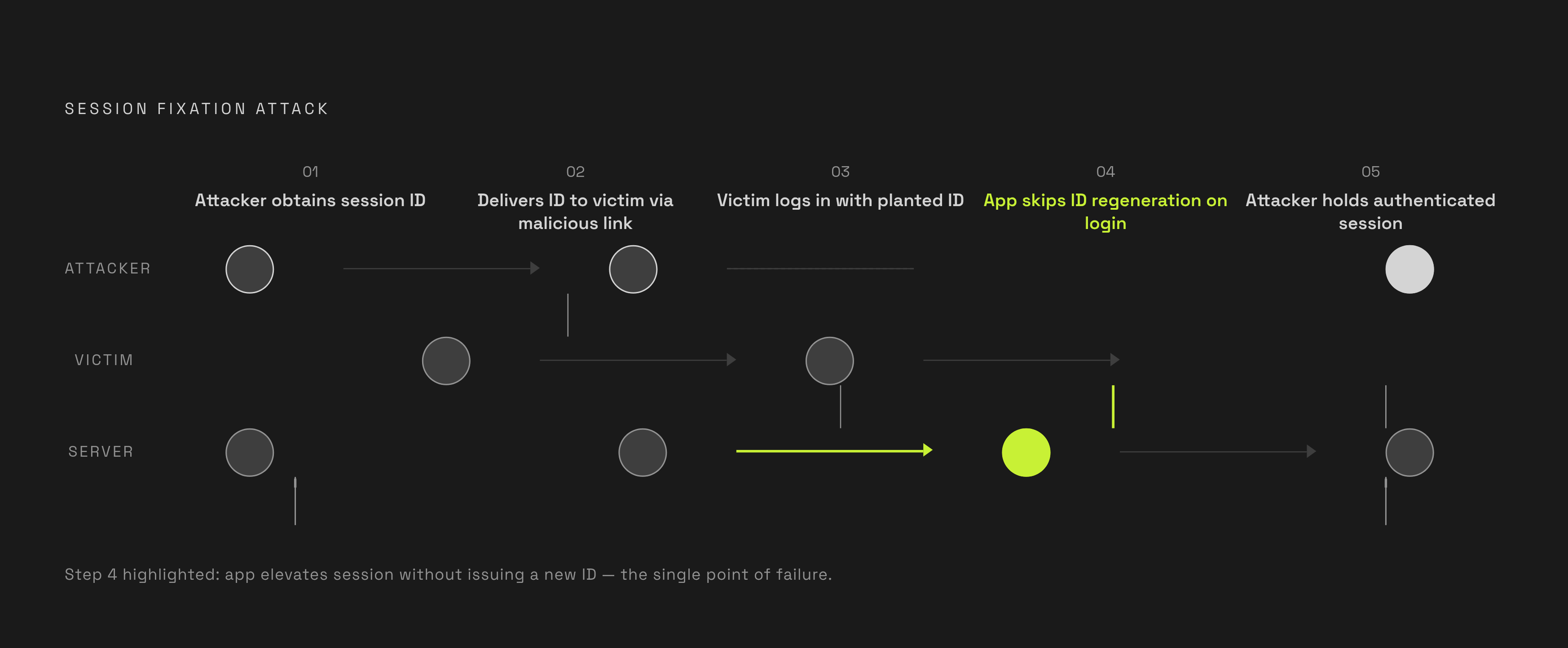
Fixation flips the timing entirely. Instead of stealing a token after someone logs in, the attacker plants a token before the victim ever authenticates, then waits for the login event itself to turn that known token into a fully privileged session.
The flaw that makes this possible is specific: the app accepts a session ID from outside, and it doesn't issue a fresh one once the user logs in. Walk through it step by step:
The attacker opens a session with the target app and gets a session ID, or crafts one to hand over directly. That ID gets delivered to the victim, maybe through a malicious link, a phishing message, an XSS injection, a CSRF request, or just physical access to a shared device. The victim clicks through and logs in, using the session ID the attacker already knows. The app elevates that existing session to authenticated status instead of generating a new one. At that point the attacker, who's known the ID the whole time, has access to a fully logged-in session.
Delivery methods vary but the pattern doesn't: a URL with the session ID baked in, a man-in-the-middle intercepting and injecting a known ID, an XSS script that sets the cookie before login happens, a CSRF request that forces the browser to initialize a known session, or someone with a few minutes of physical access to a logged-out browser.
Most modern frameworks handle this correctly by regenerating the session ID automatically at login, which closes the door fixation needs open. But "most" isn't "all." Fixation still shows up in legacy code and in frameworks that were configured wrong somewhere along the way.
It shows up a lot, in fact, in CMS and plugin ecosystems, where an authentication module gets bolted onto a base platform that wasn't built with that module in mind. Drupal's TFA module carried CVE-2024-13279, per Drupal Security Advisory SA-CONTRIB-2024-043. Joomla had CVE-2010-1434. MediaWiki had CVE-2012-5391. Magento had CVE-2019-8116. Different platforms, same root cause: layered authentication reintroducing a risk the base framework had already solved.
Java and J2EE environments have their own long history here. Apache Tomcat alone has a documented CVE series running from CVE-2013-2067 through CVE-2014-0033, CVE-2015-5346, CVE-2019-17563, and CVE-2025-55668.
Multi-tenant SaaS adds a structural wrinkle: when tenant subdomains share a parent domain, an attacker with write access to one subdomain's cookies may be able to fix a session on the parent domain itself, no code vulnerability required beyond the shared domain structure.
The 2021 CVS data breach is a useful, concrete case of what session hijacking flaws cost in practice. Misconfigured databases let an attacker pull healthcare data through a session hijacking attack, and the resulting assessment found a significant volume of confidential user data potentially exposed.
Where modern SaaS architectures are structurally exposed
Multi-tenant subdomain setups create a fixation surface just by existing. When tenant subdomains all sit under one shared root domain, a cookie set on one subdomain can, depending on how the domain scope is configured, be accessible in ways that cross tenant boundaries. That's not a bug introduced by sloppy code. It's a byproduct of how the domain structure was designed.
API-first and microservice architectures carry a different version of the same exposure. Services pass JWTs and OAuth bearer tokens between each other instead of browser cookies, and a single stolen or forged token can carry trust across every service configured to accept it. One token, many doors.
JWTs bring their own specific failure modes. Loose validation can let an attacker slip through with a token that shouldn't be trusted at all: accepting the "none" algorithm, signing with a weak secret, or skipping expiration checks are the common culprits. And unless the token is bound to something about the client, it stays valid from any IP address or device that presents it.
Single sign-on multiplies the blast radius further. A compromised session at the identity provider level doesn't cost one app its security, it costs every connected application tied to that IdP. Fixation or hijacking at that layer is never a single-account problem.
Third-party plugins and integrations round out the picture. Payment integrations, customer portal add-ons, CMS plugins, all of them tend to bring their own session handling, and that handling frequently sits outside whatever protections the core framework already has. That's the same pattern behind the Drupal, Joomla, MediaWiki, and Magento CVEs mentioned earlier, just playing out again across newer platforms.
The mitigations that actually close the gap
Regenerating the session ID on every authentication event is the single most direct fix for fixation. No exceptions for "remember me" flows, no exceptions for SSO callbacks. If a login event happens, a new session ID needs to come with it.
Cookies need a baseline set of attributes, full stop:
HttpOnly keeps JavaScript from reading the cookie, which directly blocks XSS-based cookie theft. Secure limits the cookie to HTTPS connections, closing off plaintext sniffing. SameSite=Strict or Lax reduces the risk of cross-site request abuse as a fixation delivery method. Strict applies broader cross-site restrictions; Lax is less restrictive and permits some cross-site navigations. Domain scope should be as narrow as it can possibly be. Don't set a cookie on the root domain when only one subdomain actually needs it.
TLS needs to be everywhere, no carve-outs. That stops sniffing and sidejacking over plaintext channels, though it's worth being honest that XSS can still expose a session cookie even on a fully encrypted connection, since the attack happens inside the browser, not on the wire. Weak cipher suites or anything running TLS 1.1 reopens a door that should already be shut.
Session lifetimes determine how long a session survives inactivity and how soon it forces re-authentication, so treating them as an afterthought leaves stale sessions live longer than they should. Idle timeouts should kill a session after a stretch of inactivity, and absolute timeouts should force re-authentication after a set window no matter how active the user's been. Logout needs to destroy the session server-side, not just clear a cookie on the client and call it done.
A Content Security Policy narrows down which origins get to run scripts on a page, which shrinks the XSS surface feeding cookie theft in the first place. It won't eliminate XSS, but it limits what a script that does get injected can actually reach.
Binding a session to client context, such as an IP address or device fingerprint, means a replayed token from a different context can be rejected, which helps limit token replay risk in cloud and API environments.
JWTs need their own hardening on top of all this, so reject the "none" algorithm outright, check the iss, aud, exp, and nbf claims on every single request, and keep access tokens short-lived while treating refresh tokens like the high-value secrets they are, with their own rotation schedule.
Session IDs should never come from URL parameters. Embedding them in URLs exposes them through server logs, browser history, and Referer headers, making them a straightforward fixation payload to deliver via a crafted link. Any externally supplied session ID that doesn't match something the server generated itself should get rejected outright.
XSS prevention belongs on this list too, not as general hygiene but as a direct session control. Output encoding, parameterized rendering, and staying away from innerHTML with untrusted input all cut off the dominant path attackers use to steal cookies in the first place.
Anomaly detection rounds it out: flag the same session token showing up from wildly different IP addresses, user agents, or locations in a short window. It won't stop a hijack from happening, but it shortens how long the attacker gets to use it.
Why a point-in-time scan won't find these vulnerabilities in your application
Most of what's described above is a logic flaw, not a signature a scanner can pattern-match against. A scanner can confirm HttpOnly is set on a cookie in about a second. It cannot tell whether the application actually regenerates the session ID on login, because that requires walking through the login flow itself and watching what happens, not just inspecting a header.
Every specific flaw covered here, missing session regeneration, accepted external session IDs, loose subdomain cookie scope, JWT validation gaps, needs a tester acting like an attacker would: chaining requests across an entire authentication lifecycle, not checking boxes against a static list of headers.
Compliance-driven testing runs into the same wall from a different direction. A pen test scoped to satisfy a checkbox requirement covers whatever surfaces the regulation names, and session handling logic usually lives in the gaps between those named surfaces, not inside them.
Catching these flaws for real takes a few specific things: whitebox access to the session management code, so a tester knows whether session_regenerate_id() gets called and with what parameters instead of guessing from HTTP responses, and manual testing across the full authentication lifecycle, pre-auth session state, the login transition itself, post-auth token properties, logout invalidation, and timeout behavior. Skip any one of those stages, and the exact vulnerability that matters most is the one most likely to slip through unnoticed.