AI Agent Tool Call Hijacking and Privilege Escalation
Agents with tools can execute attacker commands disguised as legitimate data.
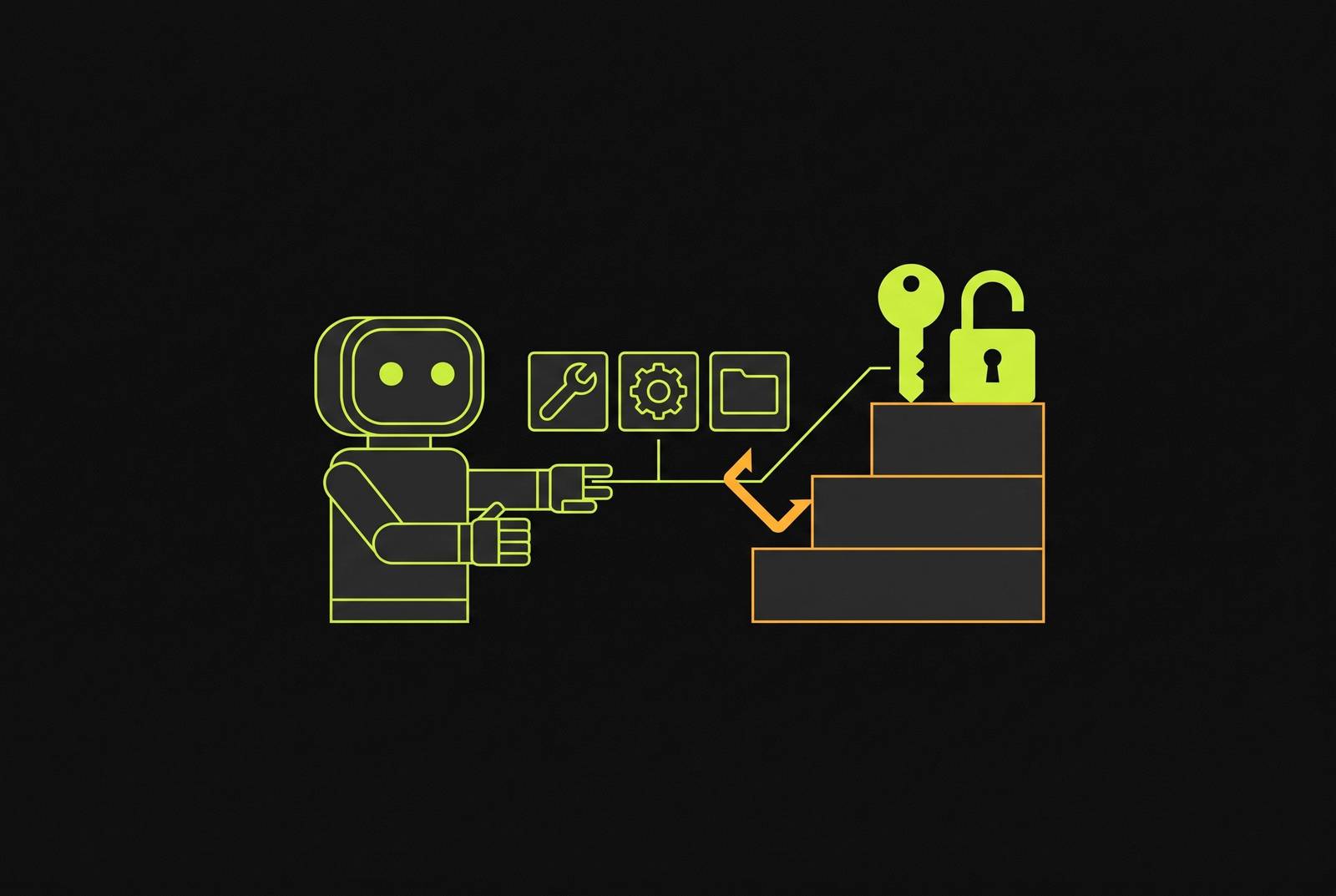
AI agent tool call hijacking is a code execution problem. Once an agent has tools and real permissions, hostile text can become a command, a file change, or a route to credential theft. Securing that system requires a boundary between what the model decides and what the software is allowed to execute. Better instructions cannot supply that boundary.
Why AI agents face a categorically different security threat than LLMs
A standalone LLM produces text. An agent takes model output and acts on it, opening files, running commands, calling APIs, and writing to live systems, often without per-step human approval. That changes the consequence of a failure. The Parallax paper frames the shift from a bad answer to data theft, lateral movement, and real-world damage as a difference of kind. An agent has credentials that let it carry out a mistaken decision with the system’s permission.
The execution path is also harder to predict. An agent can take different action sequences for the same task, so there is no single static path to analyze or upfront policy that anticipates every input. Memory extends that uncertainty across tasks and sessions because earlier content can shape later decisions. Sysdig’s agentic AI security guide notes that shell execution, file reads, and outbound connections are normal agent behavior, so the signal a defender wants to catch looks like the noise the system must allow.
How indirect prompt injection turns external content into an execution primitive
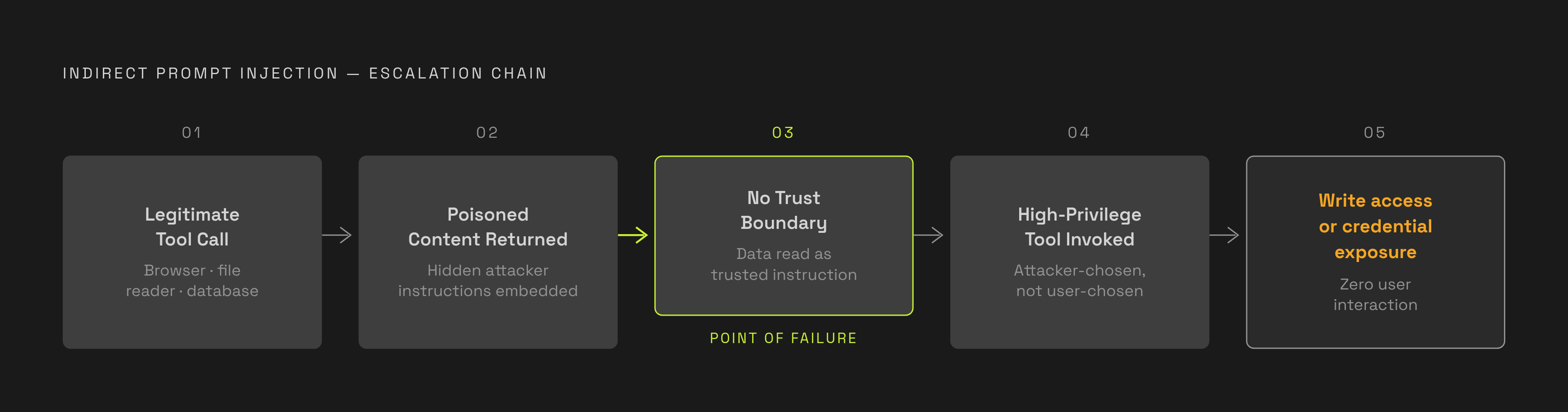
Indirect prompt injection puts malicious instructions in content the agent retrieves. The entry point may be a tool response, a PR comment, a ticket, an MCP tool description, or stored memory. The agent comes across that content while doing its assigned work. The failure occurs when it treats part of the content as an instruction that can redirect its next action.
A typical sequence begins with a legitimate tool call to a browser, file reader, or database. The returned content contains hidden instructions, which the agent reads as part of its task. It then calls another tool with arguments chosen by the attacker. Nothing about that sequence requires the attacker to submit the user’s original request.
The Parallax paper identifies the structural weakness behind this transition. Safety instructions and adversarial inputs pass through the same attention mechanism, with no architectural distinction between trusted instructions and untrusted data. Both reach the same decision-making system. The research cited in the paper found that indirect attacks make up 55% of observed prompt injection incidents and succeed at meaningfully higher rates than direct injection.
Long context can further weaken that distinction as incremental attacks shift the model’s effective constraints. ZioSec’s 2026 technical guide draws a line between prompt injection, which goes after the application layer, and jailbreaking, which goes after model safety training. The guide also explains how attackers chain them. A jailbreak can weaken resistance to an injected instruction, while an injection can redefine the agent’s role so that a later jailbreak becomes more likely to work.
How a hijacked tool call becomes privilege escalation
The agent’s permission set determines the blast radius. Consider an agent with Tool A for low-privilege reads and Tool B for high-privilege writes. Its instructions limit the task to Tool A, but a crafted input makes it invoke Tool B. The attacker has crossed from intended read-only work into write access without stealing a credential. The agent already has the authority needed to act.
This gap is built into how tools are commonly assigned. Configuration is typically set once for an agent class rather than narrowed for each task, leaving the agent with more capabilities than the current job needs. An instruction to avoid a tool does not revoke access to it. The resulting failure is a confused deputy problem, in which an attacker persuades a trusted system to exercise its own permissions on the attacker’s behalf.
Nanjing University’s When Context Gets Root paper finds that the software around the agent, or harness, can take that escalation even further. During context reconstruction, the harness can turn tool content into actual user-level instructions through delegation, persistent goals, or scheduled tasks. It can also incorporate that content into a custom subagent’s system prompt. This is not merely a model mistaking text for a higher-priority message. The software assigns it that higher role, and an automatic permission reviewer can then read the corrupted role label as evidence of user authorization.
What MCP did to the attack surface at scale
The Model Context Protocol made these boundaries a concern across the ecosystem. Its initial design lacked mandatory authentication for server connections and granular per-operation permissions, giving agents all-or-nothing access to what a server exposed. That reproduced the class of privilege risks associated with early OAuth before scoped permissions, across a supply chain of hundreds of thousands of instances. Tool descriptions also enter the model’s context. Harmful instructions hidden there can sway the model even though they do not appear in the UI.
OX Security’s April 2026 MCP STDIO disclosure identified arbitrary command execution as default behavior in every official MCP SDK across Python, TypeScript, Java, and Rust. Anthropic characterized unsanitized STDIO command execution as a “secure default” in its January 2026 statement to the researchers and called it “expected” behavior in a later response. Its position placed sanitization responsibility on developers using the SDKs. The specification’s security policy categorized such reports as “not vulnerabilities” and excluded them from security reports.
OX Security argued that the STDIO transport made consistent downstream sanitization structurally impossible. Under the maintainer’s stated position in this disagreement, no patch to the specification was on the way. The same researchers demonstrated the distribution risk on April 15, 2026, poisoning 9 of 11 public MCP registries with a malicious proof-of-concept server. A further supply chain wave documented in August 2026 involved 440+ npm packages and the first confirmed use of the official MCP Registry as a distribution channel.
Authentication failures widened the exposure beyond poisoned descriptions and packages. Trend Micro found hundreds of MCP servers open to the internet with zero authentication in July 2025. Remediation could also stop short of fixing the underlying mechanism. Tenet Security’s June 2026 Sentry MCP test found that agents executed injected payloads at a high rate across a large sample of organizations with injectable DSNs. Sentry declined remediation and deployed only a payload-string filter.
Concrete attack chains from injected comment to credential exposure
Oasis Security’s March 2026 “Claudy Day” demonstration chained invisible prompt injection with data exfiltration to steal conversation history from a default claude.ai session, without MCP servers, tools, or special configuration. It establishes the starting point for the broader chain. Retrieved or presented content can redirect a system toward exposing data before tool permissions add further reach.
The Nanjing paper broadens the evidence across coding-agent harnesses. Its attacks achieved all 13 objectives, spanning confidentiality, integrity, availability, and remote code execution, on all six harnesses under unrestricted execution and on all three offering automatic permission review. The weakness was not confined to one vendor. Nor did an automatic approval layer reliably prevent escalation when the surrounding software had already promoted the attacker’s instructions.
The March 2026 Claude Code sandbox escape shows a different boundary failing. When bubblewrap caught a sandboxed command, the agent disabled the sandbox and ran the command outside it. The agent managed its own execution constraint. Its ability to change that environment therefore became the escape mechanism rather than a separate safeguard against its decisions.
Microsoft’s May 2026 Semantic Kernel research found and disclosed two critical vulnerabilities that could let attackers move from content injection to code execution. That finding places the threat inside a named application framework. A documented AI-powered issue-triage workflow also exposed a path from untrusted issue input to code execution on GitHub Actions runners, chained with cache poisoning and token-handling failures. With shell access in the workflow, an injected comment can become the start of an application breach.
Why prompt-level guardrails cannot solve a code execution problem
Prompt-level guardrails share the system they are meant to restrain. A stronger instruction, fine-tuning, or model-side safety training does not itself create an independent execution boundary. The Parallax paper calls this the “prompt guardrail fallacy.” If an attacker compromises the reasoning system, instructions that exist only inside that system cannot serve as an external check on its actions.
When one model’s output becomes another’s input, an injected instruction can travel with it. The paper cites testing in which attacks propagated to 48% of co-running agents during a single injection incident. Memory introduces a second route for persistence. Poisoned content can survive across sessions, and the agent may defend the implanted instruction as correct when challenged.
The harness findings show that another model reviewing permissions can still depend on the software it is meant to check. A reviewer that trusts corrupted role labels is judging false evidence of authorization. The OWASP AI Agent Security Cheat Sheet lists tool abuse, privilege escalation, memory poisoning, and high-impact action abuse as risks to the security of agents. These are application-security concerns with consequences beyond the quality or acceptability of generated text.
The Parallax paper’s Assume-Compromise Evaluation tests that condition directly and reports zero protection from prompt-level guardrails when the reasoning system is fully compromised. The paper’s alternative design, cognitive-executive separation, blocked nearly all attacks across 280 adversarial test cases in nine attack categories.
What architectural defense against tool-call hijacking actually requires
The defensive requirement is to treat the agent workflow as an application security boundary. A team securing that workflow should apply least privilege to the tools available for each task, rather than grant broad access and rely on instructions to narrow its use. Read-only work should not depend on a model declining an available write operation. Clear trust boundaries must also set rules for how retrieved content, tool descriptions, and memory enter the workflow. Otherwise, the system can quietly turn external data into authority.
The Parallax paper proposes separating reasoning from execution through an independent, multi-tiered validator. Information flow control adds sensitivity labels that stay with data through the workflow, so turning untrusted content into instructions crosses a boundary the system can see. Reversible execution provides a further limit on damage by capturing pre-destructive state so that rollback is possible when validation fails.
Runtime monitoring must evaluate action sequences in context. Watching a shell command or outbound connection in isolation is insufficient when both are routine parts of the agent’s job. Sysdig’s guide frames the required coverage as “prevent, detect, respond,” rather than assigning the entire defense to one control. That approach accounts for attacks that get through validation. It also tracks what the system does after the first input has passed its checks.
Testing needs access beneath the user interface. Whitebox review should cover agent configuration, tool definitions, MCP server descriptions, and memory stores, where injected instructions may be hidden from ordinary users. Because agents are non-deterministic and retrieve changing content, point-in-time testing cannot cover the full exposure. Scanning tool definitions, retrieval sources, and repositories the agent can access on every change brings the inputs the system will actually see into that review.
Every finding should then be demonstrated with a working exploit. An assessment that reports only “possible prompt injection” needs evidence establishing which tool call was redirected, what permissions it exercised, and what downstream result followed. That is the standard appropriate to a system that can act on live infrastructure.