Authorization Logic Failures in GraphQL APIs
Resolvers need their own authorization checks or attackers bypass parent permissions.
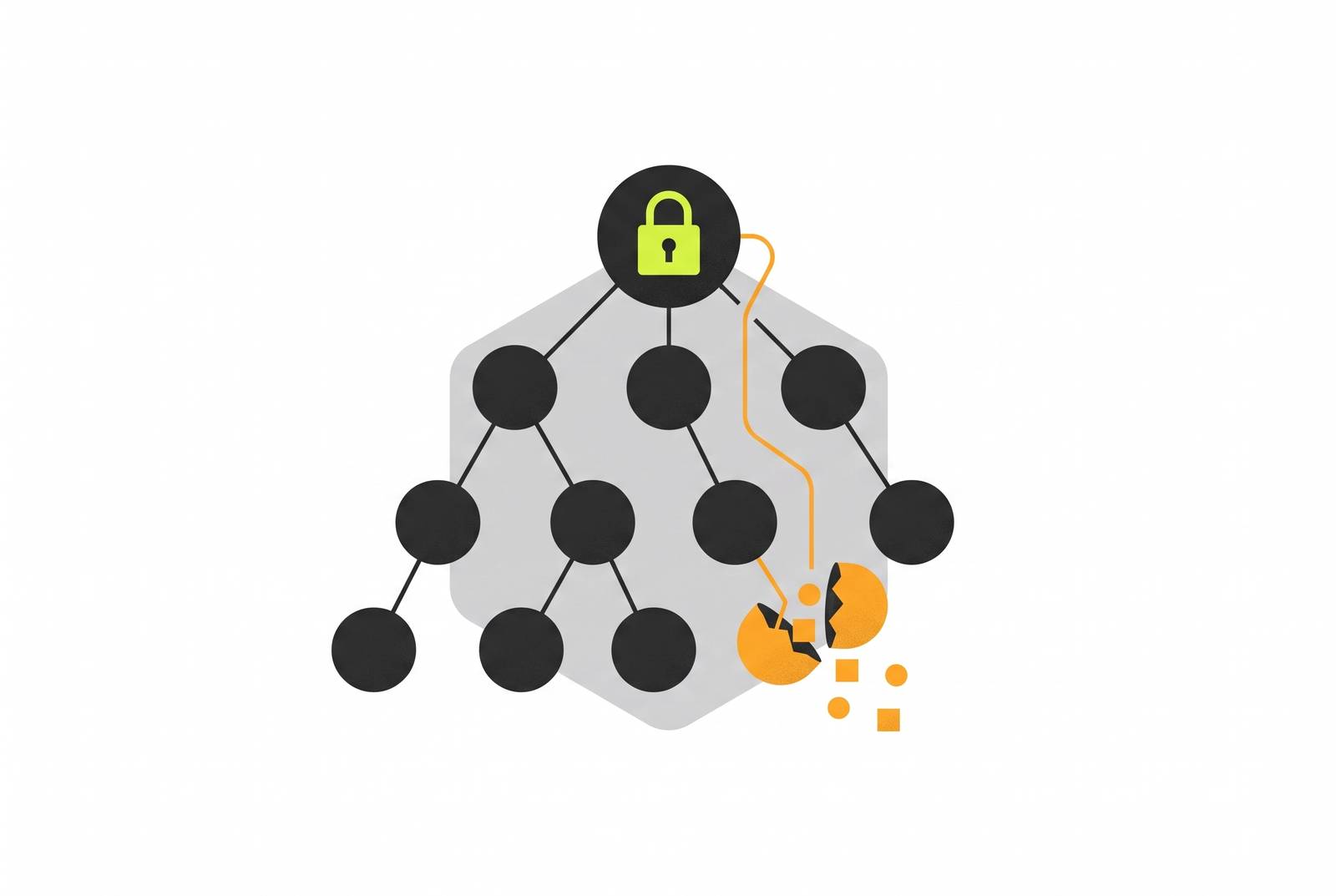
GraphQL authorization failures start with a structural mismatch. A request enters through one endpoint, but its fields resolve separately, so permission to enter does not establish permission to read or change everything inside. Protecting a GraphQL API means testing authorization at every resolver and keeping that coverage current as the schema changes. A clean endpoint scan cannot establish either.
Why GraphQL's resolver-per-field model creates a fundamentally different authorization problem than REST
A REST route gives application code a clear boundary for an authorization check that covers the response. GraphQL divides that work among the fields in a selection set, each with its own resolution function. A parent resolver may authorize access to a user object without establishing whether the caller may read user.paymentMethods. The child needs its own authorization decision. Treating the parent’s approval as permission for every child is where the gap begins.
GraphQL does not supply a built-in authorization layer. The protocol leaves access control to the application, so resolver code must enforce the rules for the data or action it exposes. This is a design responsibility. A rule applied at one point in the graph does not automatically protect other points that a query can reach. Each resolver must operate within the caller’s actual permissions.
The single endpoint makes that distinction harder to see from outside. Operations arrive at /graphql, whether they request an ordinary field or invoke a privileged mutation. Controls that check route paths cannot tell those operations apart just from where they are sent. New fields and relationships can also make the graph grow without adding endpoints.
How schema growth silently widens authorization coverage gaps over time
A new REST capability typically introduces a route that must be connected to middleware. A new GraphQL field can instead join an existing type and start returning data without touching a central access control layer. The endpoint has not changed, but the permission boundary has. Existing checks may say nothing about the new field. Unless that field is tested, its missing protection can remain unnoticed.
This makes schema evolution a security concern even when the change looks routine. Adding a relationship creates another path to data, while adding a mutation creates another way to change it. A review covers only the schema that existed when the review happened. For teams that deploy multiple times per day, the schema can outgrow the review within hours. The review retains value after its claim to complete coverage expires.
Lambers et al.’s Taint Analysis for Graph APIs Focusing on Broken Access Control, published in March 2026 in Logical Methods in Computer Science, looks at flows where one API call creates security-relevant data that another call later uses or changes without the privileges it needs. The gap can therefore span several calls. Manual schema review cannot keep pace with continuous deployment on its own, because coverage must remain testable as the graph changes.
The recurring authorization failure patterns that this structural gap produces
The first pattern confuses permission to access an object with permission to read every property on it. A caller allowed to see a username may also receive payment methods or social security numbers because child resolvers skip their checks. These are different permission questions. OWASP API3:2023 covers broken object property level authorization, while API1:2023 covers object-level failures such as accessing another user’s object by changing its ID. Both can happen when a resolver lets a caller do more than their permission allows.
Alias smuggling is another version of that misplaced trust. An attacker places an alias for a restricted field inside an otherwise permitted query, and operation-level authorization lets the field through. The alias does not grant legitimate access. Authorization was checked only at the query root, leaving the restricted field unprotected when it resolved.
Mutations turn that same mistake into unauthorized changes. A shared Mutation root can let authenticated callers use deleteOrganization, impersonateUser, or exportTenantData if each mutation has no permission check of its own. Hasura GraphQL Engine CVE-2022-46792 involved row-level authorization being mishandled in the Update Many API for Postgres backends. WPGraphQL CVE-2026-33290 shows a function-level version of this failure: low-privilege users could self-approve comments through updateComment in versions before 2.10.0.
Introspection can reveal inputs such as role, isAdmin, balance, and isVerified, which an attacker can submit if the resolver applies them without an allowlist. Discovery and exploitation are separate steps. SuiteCRM CVE-2023-47643 exposed the schema, including sensitive fields such as UserHash, to unauthenticated clients before 8.4.2. That exposure shows how attackers can learn the schema, while the ability to change each revealed field remains uncertain.
Subscriptions add a time dimension to authorization. Connection-time approval is insufficient if permissions are not checked as events arrive, including after token expiry. Directus CVE-2023-38503 involved permission filters not being properly checked for GraphQL subscriptions, allowing users to receive events they should not receive. A permissive JSON filter passed directly to a database can enable injection, while a resolver that fetches a supplied URL can enable SSRF.
Where content-type handling permits CSRF, a malicious page can cause an authenticated victim to submit a cross-origin request to the shared endpoint and invoke exposed mutations. This differs from a missing child-field check, but the testing consequence is related. The endpoint’s presence says little about the safety of each operation behind it. Coverage has to reach the resolver and the conditions under which it runs.
Why these gaps are invisible to conventional scanning and surface-level testing
A legitimate user requesting their own object and an attacker requesting someone else’s may send structurally identical HTTP requests that differ only in an ID. The response can look equally ordinary. Detecting the failure requires knowing who owns the object and what the caller should be allowed to receive. Request shape alone cannot answer that question.
Traditional DAST tools built around static endpoints, HTML forms, and known injection patterns do not show who owns an object or what the caller is allowed to receive. They cannot substitute for constructing valid authenticated queries and testing permissions between objects. Black-box testing also needs identifiers for resources that other users own. Without source access, discovering and probing those identifiers across every resolver becomes increasingly expensive and incomplete as the schema grows.
Chained operations make that blind spot wider. The taint analysis paper distinguishes direct information flows from indirect flows where other data changes occur between the source and sink calls. A test that sends just one request cannot see the whole chain. Source access lets a tester inspect child resolver checks directly, while analysis of the API graph exposes flows that need further review. Rigorous testing needs both that structural view and evidence of how the API behaves for different callers.
What rigorous authorization testing of a GraphQL API actually requires
To check coverage, teams should use schema-level analysis and cross-user dynamic tests along with human review of business rules. Teams should first map every resolver and the authorization applied to it, without treating a parent’s check as proof that a child is protected. Source access makes that inspection possible. Analysis that models information flow across API operations also covers failures that span calls and go beyond one resolver.
The taint analysis paper applies graph transformation rules and Critical Pair Analysis to the GitHub GraphQL API. Its approach examines both access that should be denied and access that should be allowed but is blocked. Excessive restriction is also a permission failure. This is why the intended access model has to guide the test, rather than a blanket assumption that rejecting more requests always means stronger authorization.
Dynamic tests should test every resolver that accepts an object identifier with objects that belong to users with different roles and tenants. That requires a harness able to authenticate as multiple users and compare responses. Testers also need to test every public-root mutation with non-admin tokens. If production introspection is disabled, testers need another way to obtain the full schema.
Subscriptions require a different test because access persists over time. Testers should keep connections open past token expiry and check whether the stream ends or authorization is re-validated, and also check that permissions are checked for each event. Human review must then connect the observed behavior to business rules, especially for tenant boundaries and chained privilege escalation. Tools can flag parts of the structure that look suspicious, but whether access is unauthorized depends on the context. Each finding should include a working exploit.
Why point-in-time testing fails to keep pace with continuously evolving GraphQL schemas
Even a thorough test establishes coverage only for the schema it assessed. Adding a field or mutation creates another resolver with protection that the earlier test did not check. Existing authorization code may remain untouched throughout that change. As a result, a report can accurately describe a past test while no longer describing the full production surface. The time gap weakens coverage.
Authorization is not the only protection exposed to that gap. Teams also need to check new types under depth and complexity limits, since they cannot assume that earlier safeguards cover them. Apollo Router CVE-2025-32032, disclosed in April 2025, was a resource-consumption flaw involving deeply nested and reused named fragments that bypassed query-planner optimization and caused thread-pool exhaustion DoS. It illustrates why a completed assessment cannot settle the security of an evolving GraphQL service indefinitely.
To maintain authorization coverage, teams should scan schema changes in pull requests against explicit coverage requirements. A new field without an authorization check can then be flagged at merge time, before production. Remediation needs its own verification step. A patched resolver should face the same cross-user and cross-role cases that exposed the original failure, rather than being treated as fixed because code changed. For a GraphQL API in a high-trust environment, rigorous initial testing plus continuous schema scanning is what authorization assurance means, and compliance-conscious teams should demand that standard from vendors.
What to verify before trusting a pen test report on GraphQL authorization coverage
To judge a report, start with what it can demonstrate about scope. It should identify every resolver tested. Child resolvers should appear as independent authorization targets. Every mutation on the public root should also be in scope, with an explanation of how the full mutation surface was obtained if introspection was unavailable. A report needs full schema enumeration to back up a claim of complete authorization coverage.
The report should identify the credentials used for each tested role, the object IDs supplied, and the responses returned. A risk label is not an exploit. A confirmed finding needs the specific query or mutation, the token used, and the unauthorized data or action it produced. That evidence distinguishes a demonstrated cross-user or cross-role failure from a general warning about BOLA or BFLA.
For APIs with subscriptions, the report should address token expiry and per-event authorization rather than stopping at connection-time authentication. It should also show whether remediation was retested against the original failure cases. These details reveal what the testing actually covered. A sample report limited to automated scanner output about TLS configuration or CORS headers does not demonstrate manual resolver-level authorization testing. The report earns trust through evidence that permission boundaries were tested across the graph.