Privilege Escalation via Mass Assignment in REST APIs
Attackers can gain admin access by injecting privileged fields into REST API requests.

Mass assignment privilege escalation is not a bug in the traditional sense. It is a framework convenience feature being used against you. Understanding the full attack chain is the only way to build REST APIs that do not silently hand attackers administrative access.
Why mass assignment is a vulnerability class, not a coding mistake
Modern web frameworks offer a feature to automatically bind incoming request fields to model properties. The developer writes one line and every field is set. That is the feature working exactly as designed. The vulnerability enters later, as the model accumulates privileged fields over time. Fields like is_admin, role, emailVerified, account_balance, and tenant_id get added to the schema. The endpoint still binds the whole object without asking if the caller is allowed to write each property.
A code reviewer checking if a value is valid never sees the problem. The field is accepted, the type is correct, the request is authenticated. Nothing signals attack at the HTTP transport layer. The vulnerability sits at the data-binding layer, between the request body and the database write. That layer sits outside the scope of most input validation and WAF controls.
This is why mass assignment survives code reviews that only check whether input is well-formed. The reviewer looks for bad values. The attacker is sending perfectly good values to fields they should not be able to touch at all. OWASP recognized this in its 2023 API Security Top 10 update. Mass assignment was absorbed into API3:2023, Broken Object Property Level Authorization. It pairs with excessive data exposure as two faces of the same property-level control failure. The flaw is structural, not accidental.
How the attack chain runs from reconnaissance to full admin access
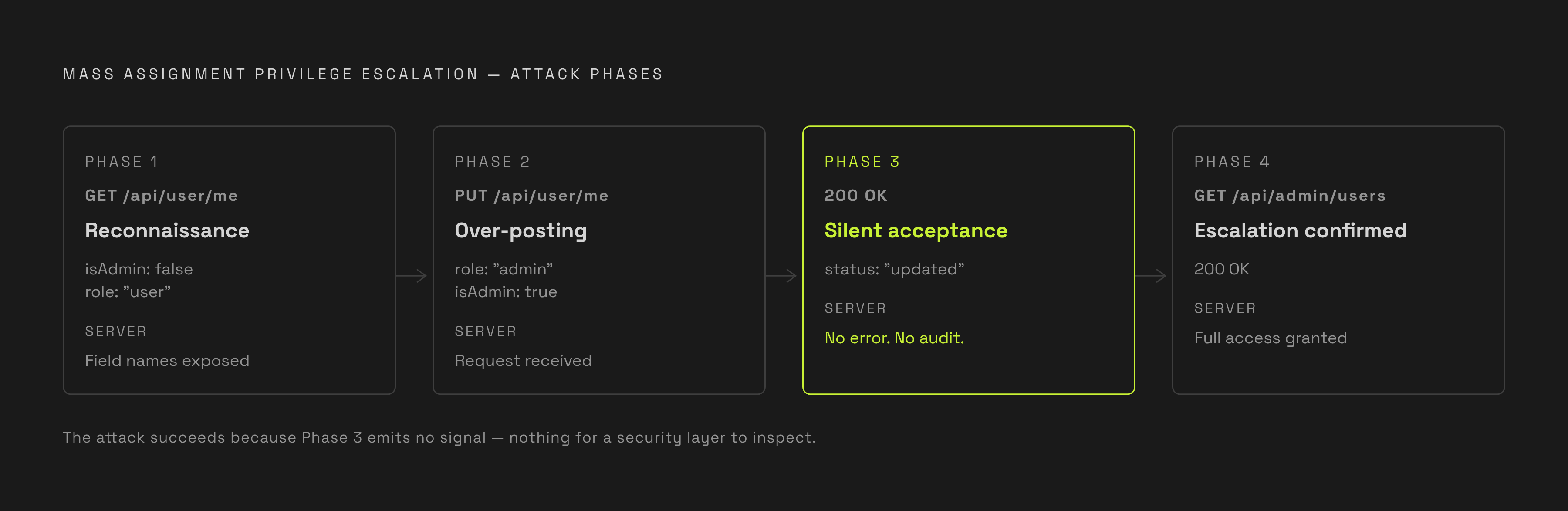
An attacker does not need documentation, special tools, or exploit code. A GET request and a modified PUT request are all it takes. The full chain runs in four phases.
Phase one is reconnaissance through normal API responses. The attacker issues a GET request to an endpoint and reads the JSON response. The response reveals the model's field names. If the response includes "isAdmin": false, that field name is now a candidate for injection. The API itself is handing over the attack surface.
Phase two is over-posting the privileged field. The attacker replays the same field in a PUT or PATCH request, adding "role": "admin" or "is_admin": true to the body alongside the legitimate fields the endpoint expects. The request looks like any other update.
Phase three is silent server-side acceptance. The server returns no error, no warning, and no audit log entry distinguishable from a normal update. Just "status": "updated". Nothing in the infrastructure notices anything unusual.
Phase four is confirming escalation. A follow-up request to an admin-only endpoint, such as GET /api/admin/users, succeeds with the same token. One request, full admin access. The exploit complexity is very low. Detection is rated near zero because the request looks legitimate at every layer security tools inspect.
Beyond role escalation, the attack surface widens. The same binding pattern exposes financial fields like price, discount, balance, and creditLimit. It exposes status fields like verified and emailConfirmed. It also exposes relationship fields like ownerId and organizationId. Each enables a distinct class of business-logic abuse.
Three attack variants that go beyond the obvious role field
The isAdmin case is only the most visible form. The same flaw enables zero-click account takeover, cross-tenant data access, and in some stacks command-level impact through backend-only processing options. Zero-click account takeover works through token overwrite. During a password reset flow, injecting a fake token into the id parameter of a POST to /resources/auth/resetPasswordLink replaces the legitimate reset token. The attacker then resets the password without any victim interaction. The victim never clicks anything.
Blocking administrative functions is another variant. Manipulating provider and type parameters with arbitrary values on a profile management endpoint prevented administrators from deactivating accounts or resetting two-factor authentication. The same application's /organization/members endpoint was not vulnerable. Inconsistent per-endpoint validation creates unpredictable exposure.
Multi-tenant boundary crossing uses ownership and organization-related fields. Fields like ownerId, userId, organizationId, and team_id let an attacker move an object from their own tenant to another. The chain runs from mass assignment to ownership change to authorization bypass to unauthorized data access. One null field, moved into another tenant's context, breaks the isolation model.
Nested object injection is subtler. Allowlists applied only at the first level of a JSON body leave nested objects unprotected. Sending "owner": {"id": 1, "is_admin": true} inside a project update can escalate privileges through Rails' accepts_nested_attributes_for, Django REST's nested serializers, or Spring's cascade behavior.
Content-type parser confusion adds another path. If an endpoint accepts both application/json and application/x-www-form-urlencoded but the allowlist logic was written for only one parser, switching Content-Type headers can expose the unguarded binding path. Backend processing option injection takes the impact further. When writable fields include transcoding flags, template selectors, or webhook destinations, the impact escalates past privilege escalation into SSRF or arbitrary workflow execution. None of these variants is fixed by checking that a value is well-formed. Input validation does not touch them.
Why input validation does not fix this and what actually does
Input validation checks whether a field's value is well-formed. It cannot fix mass assignment because the problem is that the field is accepted at all. A role field that is validated as an accepted string value is still writable by an attacker who sends "role": "admin". Validation confirmed the value is a valid string. Nothing restricted whether the caller may set that property.
Blacklisting known-dangerous fields fails as new model fields accumulate. Blocking isAdmin and role today does nothing when the next new field appears. Allowlisting known-safe fields is the only pattern that stays correct as the schema grows. The allowlist must also be endpoint-specific, not model-wide. The same model is served to callers with different permission levels. A registration endpoint permits name, email, and password. An admin user-management endpoint may additionally permit role and enabled.
The fix is an explicit per-endpoint allowlist applied before the database write. In Express with Mongoose, the vulnerable patterns are User.create(req.body) and Object.assign(existingUser, req.body). The fix is explicit field extraction before the call. The pattern const { name, email, password } = req.body isolates only what callers may set. Grep the routes directory for create(req.body, Object.assign.*req.body, and...req.body to find every instance.
In Django REST Framework, ModelSerializer exposes all model fields as writable by default. The fix is setting read_only_fields = ['is_staff', 'is_superuser', 'groups', 'date_joined'] in the serializer Meta class, or allowlisting with fields = ['id', 'username', 'email']. Review every ModelSerializer in the codebase for unexpectedly writable privileged fields.
In Spring Boot, using @RequestBody directly with a JPA entity exposes every entity field. The pattern @PostMapping('/users') public User createUser(@RequestBody User user) is the problem. Replace the entity with a dedicated DTO that contains only the fields callers may set. Use @JsonProperty(access = JsonProperty.Access.READ_ONLY) on entity fields that should only be returned, never accepted.
In Ruby on Rails, Rails 4+ requires strong parameters via permit(). The pattern params.require(:user).permit(:name,:email,:password) allowlists only the three safe fields and silently discards everything else. Grep for.permit!, which bypasses the protection entirely, and any User.create or.update call that does not route through a strong parameters filter.
Verifying the fix and adding an automated regression layer
Applying an allowlist is necessary but not sufficient. Every remediated endpoint needs a verification test that proves privileged fields are rejected, plus an automated regression layer that catches the pattern if it reappears in a future pull request. The manual verification test is straightforward. After applying the fix, send a request to the remediated endpoint with additional privileged fields in the body. For a registration endpoint, POST /api/users with {name, email, password, role: 'admin', isAdmin: true}. Confirm that registration succeeds, but a subsequent GET /api/users/{id} returns role at its default value and isAdmin as false.
A response that accepts the extra fields without error but silently discards them is the correct behavior. A response that rejects the request entirely may indicate an overly strict schema that breaks legitimate use. Distinguish between the two.
The automated test suite adds durability. Add tests that POST or PATCH every endpoint with a superset of the allowed fields, including known-privileged field names. Assert that the privileged fields are not persisted. Run these in CI so a future developer cannot accidentally reopen the vulnerability by changing a serializer or adding an ORM shortcut.
Schema validation adds a second layer. Configure additionalProperties: false in the OpenAPI or JSON Schema definition for each request body. This rejects at the framework level any field not declared in the schema, before it reaches the binding layer. It is a complementary control, not a substitute for the allowlist. These tests are exactly what a rigorous pen test should be verifying.
What a real pen test does with mass assignment that a checkbox test misses
Mass assignment is the archetype of a vulnerability that a checkbox compliance pen test will miss and a whitebox test with authenticated, code-level access will find. The flaw is in the data-binding layer, invisible at the network perimeter but obvious in the source. A blackbox tester with no documentation and no code access must guess which fields exist in the model. The attacker's own reconnaissance method, reading the GET response to find field names, is exactly what a blackbox tester does. Test quality is bounded by what the API happens to return in responses. Fields the API does not echo remain invisible.
A whitebox tester with source code access can grep for create(req.body, Object.assign.*req.body,.permit!, and every ModelSerializer in minutes. This covers the entire attack surface, not just endpoints that surface field names in responses. The severity assessment also shifts. The question is not just whether a field can be written, but what the downstream impact is. Does writing organizationId move data across tenant boundaries? Does a writable processing flag enable SSRF? That chain-of-impact analysis requires code and cloud configuration context that a point-in-time external scan cannot provide.
Annual compliance-driven pen tests have a structural flaw. Their scope calibrates to the minimum the compliance requirement demands, not to what reduces risk most effectively. A new endpoint added three days after the test window closes is not in scope until next year.
Mass assignment vulnerabilities are introduced at the code level. A developer adds an ORM shortcut, a new model field appears, a serializer is not updated. That means they can appear on any pull request. Continuous pull-request scanning catches them at the moment of introduction rather than months later.
Every finding in a rigorous pen test should be proven with a working exploit. For mass assignment, that means a demonstrated privilege escalation or data manipulation, not a theoretical note that the framework supports auto-binding. Unverified maybes do not belong in a report that will be shown to auditors or enterprise customers.
How mass assignment findings fit into SOC 2, HIPAA, and ISO 27001 audit evidence
A pen test that finds and proves a mass assignment privilege escalation, and documents its remediation, satisfies the access-control and risk-treatment evidence requirements across SOC 2, HIPAA, and ISO 27001 more credibly than a clean report that missed the vulnerability entirely. SOC 2 Type II does not explicitly require a pen test. Yet a recent pen test with demonstrated findings and remediation is commonly used as evidence for Trust Services Criteria covering logical access controls. A report that proves a privilege escalation vulnerability was found and fixed is stronger evidence than one that reports no findings.
HIPAA does not explicitly require pen testing under the current rule. It is risk-based. An HHS proposed Security Rule update from January 2025 would require annual pen testing if finalized. Organizations that already have a continuous testing program are structurally ahead of that requirement. ISO 27001:2022 does not name pen testing by that term but expects it, documented under Annex A controls 8.8 and 8.29, with findings feeding the risk register and risk treatment under Clause 6.1.3. A mass assignment finding with a working exploit and a verified remediation maps directly to the evidence an auditor expects under those controls.
PCI DSS v4.0.1 explicitly requires pen testing annually plus after significant changes under Requirement 11.4. A new API endpoint or a model change that introduces mass assignment exposure qualifies as a significant change. That is exactly what continuous pull-request scanning is designed to catch between annual test windows.
The common thread across all four frameworks is that compliance functions as a floor, not a ceiling. An organization that treats the annual test as a box to check will resurface the same vulnerabilities the following year. One that treats the test as genuine threat discovery uses the findings to build controls that hold. Mass assignment is dangerous because it exploits a feature, not a bug. Finding it reliably requires whitebox access, human review, and continuous scanning. That same combination is what makes both compliance and real security the same outcome.