LDAP Injection in Directory-Integrated Authentication Systems
Unchecked input in LDAP queries can bypass authentication across your entire directory.
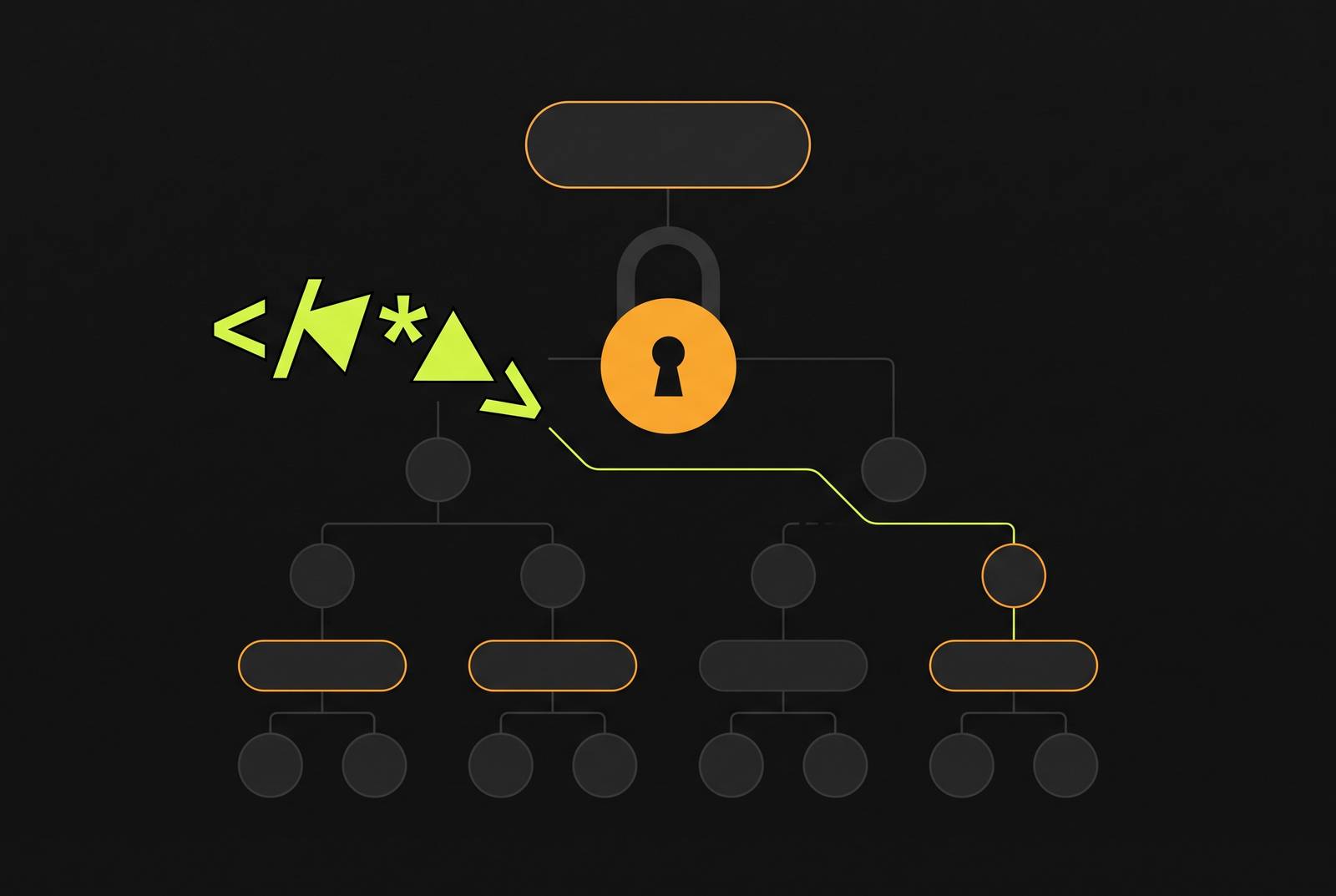
LDAP injection in directory-integrated authentication systems turns unchecked user input into authentication bypasses and data exposure. The risk reaches beyond one application because the directory governs access across the organization. Defenses hold only when engineers understand how filters work, keep user input out of query logic, and limit what application accounts can reach.
Why LDAP sits at the center of enterprise identity infrastructure
LDAP answers a basic enterprise question about who can access what. It organizes identity data in a hierarchical Directory Information Tree, or DIT. Each entry has a Distinguished Name, or DN, and attributes such as uid, memberOf, and userPassword. Applications use that shared structure to look up users, check group membership, and make access decisions.
Web application logins, VPN gateways, Wi-Fi controllers, HR portals, password resets, and single sign-on events all issue operations against directories that also control access to file shares, email, and privileged accounts. LDAP lets Active Directory work with third-party applications, network devices, and Linux infrastructure. A fault at this layer therefore reaches beyond the application where it starts. The directory trusts that each filter it receives expresses the application's intent, with no way to distinguish a legitimate query from one altered by an attacker.
How LDAP filter syntax turns user input into executable directory logic
In LDAP search filters, operators come before the conditions they join. In (&(uid=INPUT)(userPassword=HASH)), the & means both conditions must be true. Other structural characters include | for OR, ! for NOT, * for a wildcard, and parentheses for grouping.
The boundary breaks when an application inserts user input directly into that structure. A minimal vulnerable Python statement is search_filter = f"(&(uid={username})(userPassword={password_hash}))". Here, concatenation means placing the supplied username inside the filter without first making its special characters harmless. If the username contains filter syntax, the directory receives that syntax as part of the query.
MITRE classifies this failure as CWE-90, Improper Neutralization of Special Elements used in an LDAP Query. It shares SQL injection's root cause, but LDAP has historically lacked the built-in parameterized query interfaces available in mature database libraries. This makes building strings tempting, but it remains unsafe. Search filter values need RFC 4515 escaping, while Distinguished Names need a different treatment under RFC 2253. Escaping for one context does not protect the other.
The four attack patterns that define the LDAP injection threat
Authentication bypass is the most direct consequence. A username such as * changes an exact match into a wildcard match, which can undermine authentication when the remaining filter and application logic permit it. More complex input, such as )(uid=))(|(uid=*, attempts to reshape the surrounding Boolean expression. The result depends on the complete query and how the application handles returned entries, particularly whether it accepts the first result as the authenticated user. The dangerous combination is attacker-controlled filter structure and authentication logic that trusts the resulting match.
Enumeration uses the same grammar to read directory data. A user-lookup form intended to return one match can return every object with a cn attribute if it accepts * as a search term. If input controls the search bases or scopes, the search can reach beyond its intended subtree. The exposure grows with the containers and attributes the application can read.
Blind injection can work even when directory records are hidden. Conditions such as (attribute=a*) and (attribute=b*) can produce different responses, including a result or an empty page. Those differences let an attacker infer attribute values character by character. The data therefore stays at risk even if fewer fields are shown.
DN manipulation changes the target of an operation. In an application that builds a DN from a username, input such as alice,ou=admins can insert a container into the constructed name. Depending on the surrounding DN, this can redirect a bind toward a privileged container. Correct filter escaping alone leaves this separate construction path unprotected.
Recent CVEs that show LDAP injection in shipped software
CVE-2026-31828 in Parse Server allowed authenticated low-privilege users to escalate to any restricted group through LDAP filter injection. The attacker already had an account. Strong passwords and perimeter controls did not fix the way queries were built along that authenticated path.
CVE-2025-12764 in pgAdmin showed a different consequence within an authentication flow. LDAP injection caused excessive data to overwhelm the LDAP server and pgAdmin client, producing denial of service and cascading authentication failures across dependent systems. The directory became an availability risk as well as a source of identity data. Together, these cases show why assessment cannot stop at unauthenticated login bypasses.
Where LDAP injection hides in a typical application attack surface
The inventory starts with every place that accepts input for a directory operation. That includes login forms, employee lookup pages, password reset flows, corporate directory portals, and VPN authentication pages. Internal tools and background services also matter when they pass supplied values into LDAP queries. Treating LDAP injection as only a login problem leaves these other paths outside the review.
Each path needs its own construction model. A search page may build cn=INPUT*, while a login form combines identity and password conditions with AND. A DN-building function introduces another context entirely. The review must identify where input becomes structure in each context.
The application's bind account defines the reach of an injected operation. Its permissions, rather than the page's intended purpose, determine which directory data can be exposed. If the account can read a wide range of sensitive attributes, it may expose email addresses, group memberships, password hashes, and privileged account details. An ordinary employee lookup can therefore have far more authority than its interface suggests.
How to test for LDAP injection: from surface identification to exploit confirmation
OWASP testing guidance starts with identifying input fields used in LDAP queries or related functions. Testers introduce characters such as (, |, &, and * and examine errors, empty results, or changed behavior. Those responses identify candidates for deeper investigation. A changed response alone is not enough to explain the impact. The tester must match the payload to the actual filter and prove what it permits.
For Active Directory-integrated systems, a gray-box assumed-breach assessment starts with a standard domain user account. It covers authenticated searches, role-based directory access, and privilege boundaries that an insider could probe. Black-box testing checks paths from outside with little knowledge of the system beforehand. White-box access includes source code and details of the architecture, showing how internal tools and services build queries that an external scan cannot see.
Burp Suite Pro provides an intercepting proxy for request manipulation, while BloodHound with the SharpHound collector maps users, groups, computers, and permission relationships. Testing can also assess WAF detection through OWASP ModSecurity Rule ID 921200. The wider scope includes domain controllers, DNS, LDAP, Kerberos, high-privilege groups, security policies, and misconfigured network shares.
Automated scanners can flag obvious metacharacter handling, but they cannot reliably establish privilege escalation or the full exposure of a bind account. A credible finding needs a working exploit and an explanation of the resulting access. Repository and configuration review deepen coverage by locating the code paths behind that behavior.
Eliminating LDAP injection at the code level: input escaping, safe query construction, and library patterns
The primary fix is to stop treating user input as filter structure. Use library escaping or structured filter construction instead of a denylist of characters that look suspicious. Blocking * and ( while missing ) or NUL leaves a gap. RFC 4515 escaping converts * to \2a, ( to \28, ) to \29, \ to \5c, and NUL to \00.
In Python with ldap3, import the helper with from ldap3.utils.conv import escape_filter_chars. Then construct an identity filter with search_filter = f"(uid={escape_filter_chars(username)})". The supplied value still enters the string, but its special characters no longer act as filter operators. Apply the same treatment to every user-controlled filter value. This stops the filter manipulation used in bypass, enumeration, and blind injection.
Java with Spring LDAP has structured filter objects. Within code that has ldapTemplate, username, and password, a compact pattern is AndFilter filter = new AndFilter(); filter.and(new EqualsFilter("uid", username)); boolean authenticated = ldapTemplate.authenticate("", filter.encode(), password);. Spring LDAP's AndFilter and EqualsFilter handle escaping before the encoded filter reaches authentication.
Node.js with ldapjs also needs explicit attention to escaping because it does not apply that protection by default. In every language, raw input must not supply operators or grouping. DN construction needs its own structured approach under RFC 2253. User input must not supply structural separators that insert a container into the bind target.
Validation adds another boundary before escaping. A username field can allow only the expected alphanumeric format and a few safe symbols, while broader search fields still need full escaping for their context. Rejecting &, |, and = where the field's format excludes them complements that defense. Applications should also return generic errors that leave out LDAP details that show how the query is built.
Least-privilege bind accounts and network-layer controls that limit what a successful injection can reach
Safe construction prevents injection, while least privilege limits the damage if a flaw remains. An injected query operates with the application's service-account permissions. If that account can read sensitive attributes, change entries, or manage administrative objects, the attacker can do the same through the vulnerable operation. Directory-facing accounts should have read access only to the attributes the application needs, with no write permissions or access to privileged containers and administrative groups.
Transport and request controls protect different boundaries. Standard LDAP transmits credentials in plaintext, while LDAPS encrypts the session to protect against interception. Encryption does not make an injected filter safe. A WAF using OWASP ModSecurity Rule ID 921200 can detect and block metacharacter patterns in requests before they reach the application. It protects the application using LDAP rather than sitting directly in front of the directory server.
Monitoring supports these controls without replacing them. Directory monitoring linked to a SIEM can flag results that are unusually broad, authentication failures that keep happening, and filter patterns that look suspicious. Those signals can help show when someone is probing the system, including through blind injection.
How LDAP injection testing fits into SOC 2, ISO 27001, and HIPAA compliance requirements
For engineering leaders preparing audits, LDAP testing turns a technical risk into evidence of security assurance. A test that proves the flaw, records its impact, and demonstrates its closure can support SOC 2, ISO 27001, and HIPAA evidence needs. That does not mean all three prescribe an identical testing process. SOC 2 does not explicitly mandate penetration testing, but auditors treat it as standard evidence for Common Criteria CC7.1 and CC4.1 in Type 2 engagements. Without it, the evidence set needs documented justification and alternatives.
ISO 27001:2022 requires attention to updated vulnerability management controls during certification audits. 2013 certifications were no longer valid after the October 31, 2025 transition deadline. For testing evidence to carry weight, the scope must cover the relevant systems and the method must be recognizable. Suitable methods include PTES, NIST SP 800-115, and OWASP, supported by qualified third-party reviewers with verifiable credentials. An automated vulnerability list without qualified human review does not provide the same assurance.
Closure matters as much as discovery. PCI DSS 11.4.4 explicitly requires retesting fixes, while SOC 2 auditors expect evidence that critical findings were closed. A report documents risk, and a retest demonstrates that the fix addressed it. Both real security and readiness for audits therefore call for a thorough penetration test with working exploits, remediation retests, and a signed attestation. Security theater does neither job.