Which OWASP Top 10 for LLM Risks Are Actually Exploitable
Prompt injection, excessive agency, and disclosure are proven attack paths.
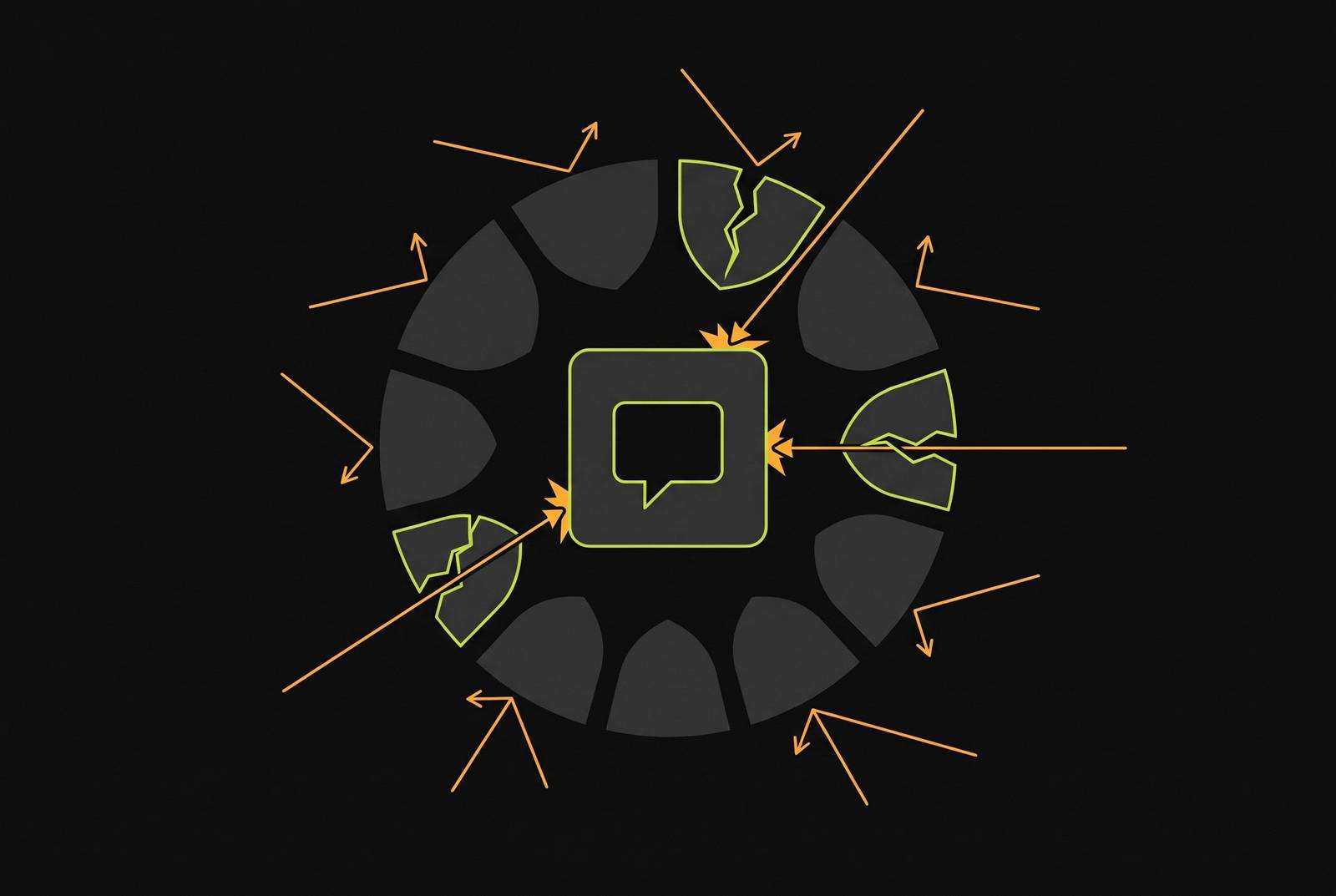
The OWASP LLM Top 10 identifies risks, but its rankings do not tell a security team which attacks will work against its deployment. Attacks that use Prompt Injection, Excessive Agency, information disclosure, and unsafe output handling have been shown to work. Assessing whether an attacker can turn a risk into stolen data, an unauthorized action, or an operational loss is more useful than knowing where it ranks.
Why the OWASP LLM Top 10 rankings do not straightforwardly track confirmed exploitation
OWASP published its 2026 edition on 4 August 2026 using a methodology that blends practitioner votes with publicly documented incidents. Votes received more weight than incident data. Most cases in the incident corpus had enough detail to classify, but that does not make the final order a count of successful attacks. Community attention and defense activity also shape the result.
Prompt Injection shows why those distinctions are important. It stayed first despite a thin logged-incident record, which OWASP describes as a “defense effect.” Active countermeasures suppress recorded incidents without making the attack rare. Misinformation went the other way, with few votes from practitioners and a high count of incidents. Working down the ranking can therefore misdirect effort toward well-defended risks while overlooking active production attack chains. Which entries have demonstrated, working attack paths right now?
What actually changed in the 2026 list and why the movements signal exploitability shifts
The 2026 order begins with Prompt Injection, LLM01, followed by Sensitive Information Disclosure, LLM02, and Excessive Agency, LLM03. Supply Chain is LLM04, Data and Model Poisoning is LLM05, and Unbounded Consumption is LLM06. Misinformation is LLM07, Hidden Context Exposure is LLM08, Vector and Embedding Weaknesses is LLM09, and Improper Output Handling is LLM10. The edition belongs beside the ID in reports and audit evidence, as in LLM03:2026. Without it, older reports can point readers toward the wrong risk.
Excessive Agency rose from sixth to third as agentic deployments grew, while Unbounded Consumption rose from tenth to sixth as reasoning models, multimodal inputs, and agent loops increased request costs. Improper Output Handling fell from fifth to tenth. Scope changed too. Prompt Injection now explicitly includes images, audio, video, and memory, while Sensitive Information Disclosure includes reasoning traces, logs, embeddings, and side channels. Hidden Context Exposure takes the place of System Prompt Leakage and covers tool schemas and retrieved policy text.
Prompt Injection has the strongest confirmed exploitation record of any entry on the list
Prompt Injection has the strongest documented production exploitation record among the entries, despite its thin count in the incident corpus. Those are different measures of evidence. Its underlying weakness is architectural because an LLM reads instructions and data in one token stream. There is no equivalent of a parameterized query separating the two. OWASP’s 2026 text concludes that “no reliable prevention mechanism exists today.”
Direct injection puts hostile instructions in the user’s prompt. Indirect injection hides them in material the model processes, including documents, emails, web pages, database records, code comments, and images. This second pattern is behind the most severe findings in production. EchoLeak, CVE-2025-32711 with a CVSS score of 9.3, used a crafted email delivered to a Microsoft 365 Copilot mailbox to collect and exfiltrate organizational data without a target click. The documented chain bypassed the prompt injection classifier and link redaction using reference-style Markdown and an auto-fetched image.
A coding-agent attack used the same trust failure. A public GitHub issue instructed an agent to read the user’s private repositories and publish its findings in a pull request on the public repository. Adding image, audio, video, and memory channels broadens that exposure. The defensive goal is therefore not an unfooled model, but a system whose permissions limit what breaks when injection succeeds.
Excessive Agency is the entry where a "wrong answer" becomes a "wrong action"
Excessive Agency turns that permission boundary into the central security question. OWASP names three root causes, namely excessive functionality, excessive permissions, and excessive autonomy. A model may have unnecessary tools, those tools may have more access than the task requires, or the model may act autonomously. Each expands the consequences of a successful injection. A bad answer can then become a file write, an API call, credential use, or an email send.
The test belongs at the tool layer. An incoming message, whether injected or legitimate, can lead an over-permissioned model to forward sensitive data or take destructive actions that the developer never intended to authorize. Practitioners sometimes call these “permission findings wearing an AI costume.” The phrase is blunt because the underlying failure is familiar. The AI surface amplifies a least-privilege failure, so testing only the model’s words misses potentially harmful tool use.
Sensitive Information Disclosure and Hidden Context Exposure are confirmed and closely linked in real engagements
Sensitive Information Disclosure and Hidden Context Exposure are often parts of the same attack chain. An adversary extracts hidden context, learns what credentials or operating logic the system contains, and uses that knowledge to escalate. LLM02:2026 covers disclosure through answers, tool calls, logs, embeddings, and reasoning traces, while LLM08:2026 covers hidden configuration such as system prompts, tool schemas, and retrieved policy text.
The Samsung case illustrates how little sophistication disclosure can require. Engineers pasted proprietary semiconductor source code and internal meeting transcripts into a third-party assistant through normal, unsanctioned use. The Bing Chat “Sydney” exposure in 2023 illustrates the hidden-context side. A direct instruction override caused the assistant to recite its operator instructions, including its internal codename and operating rules, and Microsoft confirmed that the extracted prompt was genuine. Defenses placed only in the system prompt are unreliable because extracting that prompt is itself an attack.
Improper Output Handling fell five places but the underlying risk did not shrink
Improper Output Handling’s fall from fifth to tenth reflects a ranking change that leaves the safety of production systems unproven. The move shows that the community was paying more attention to agentic risks. Meanwhile, the 2026 edition expanded the entry to include insecure code generated by coding assistants. Its scope grew as its position fell. Treating that position as a reason to reduce testing would confuse voting results with exploitability.
The failure occurs when another component trusts model output without validating it. In browsers, that can produce cross-site scripting and cross-site request forgery, while backend chains can lead to server-side request forgery, privilege escalation, and remote code execution. These are familiar injection paths reached through a new source. Downstream components need the same input validation they would apply to other untrusted data, rather than treating the model as a trusted internal service.
Unbounded Consumption is confirmed exploitable but was underrated until agentic cost structures made it visible
Unbounded Consumption targets cost and availability rather than stolen information or unauthorized actions. Reasoning models, multimodal inputs, and agent loops made denial-of-wallet attacks a real threat to systems in production. Inputs crafted for an attack can use as much compute as possible and run up damaging API bills. Agent loops can also get stuck in runaway cycles of tool calls, retrieval, and re-prompting. Multimodal inputs can also make each request costly to process.
The model itself is the target here. Unlike an injection chain that reaches a separate system, the expensive work can be the harm. This broader framing replaced the 2023 Model Denial of Service entry and now includes cost-harvesting scenarios. It does not need to outrank Prompt Injection to deserve security controls. Rate limiting and cost monitoring belong in both the security architecture and the billing dashboard.
Data and Model Poisoning and Vector and Embedding Weaknesses are real but harder to demonstrate in a time-boxed test
These entries move the attack surface upstream. Data and Model Poisoning covers corruption of training data, fine-tuning data, embedding creation, retrieval content, and continuous-learning pipelines. A backdoor introduced through those paths can remain dormant until a trigger phrase activates it. A model that behaves well during a short test therefore provides weak assurance about its inputs. Proving the attack within the engagement is difficult.
Vector and Embedding Weaknesses targets how similarity search selects material, a step separate from the model’s instruction following. Retrieval-augmented generation pipelines, vector-backed agent memory, and semantic caches make that retrieval layer part of the trust boundary. Manipulation can work even when retrieved text contains nothing overtly malicious. A supply chain compromise or poisoned retrieval index can produce persistent, stealthy misbehavior that point-in-time prompting misses. A thorough assessment therefore checks data provenance, ingestion validation, and retrieval boundaries alongside model behavior.
What a real exploitability-focused LLM security test covers that a checkbox exercise does not
For a security team turning these distinctions into a testing plan, the target must extend beyond the chat interface. An LLM assessment examines model behavior, prompts, retrieval pipelines, tools, and output handling. Traditional coverage still has a separate job. The underlying API, authentication layer, and infrastructure need standard OWASP Top 10 testing as well as the LLM-specific work. One scope does not replace the other.
The assessment must map every channel the model reads, including user input, documents, emails, tool responses, images, and stored memory. Each can provide an injection entry point. A scanner that probes only the user-facing prompt field misses most of that surface. For an agent, the assessment must also establish which tools are available, what permissions they have, and the worst action an injected instruction could trigger. The highest-severity findings often connect several entries, such as injection leading to over-permissioned tool use and disclosure.
Whitebox access makes that mapping possible through source code, system prompts, tool schemas, retrieval configuration, and cloud permissions. Interface-only testing misses hardcoded credentials in prompts, over-permissioned tool tokens, and pipeline injection points. That limitation affects the evidence a report can offer. AI-only or scanner-only platforms marketed as penetration tests do not meet the standard auditors apply to human-driven adversarial testing. Working exploit chains and business-logic findings distinguish an assessment from a catalogue of suspicious responses.
How the exploitability tiers map to what auditors actually need from an LLM security assessment
Prompt Injection, Excessive Agency, disclosure, and unsafe output handling call for attempts to prove working chains. Unbounded Consumption needs attention to financial and operational harm. Poisoning and retrieval weaknesses require pipeline review as well as adversarial tests. These distinctions guide the assessment method for each entry, all of which deserve scrutiny, and give auditors a clearer account of what was actually assessed.
Neither SOC 2 nor HIPAA names a specific penetration-testing methodology as a regulatory requirement. Auditors still use evidence of exploitation to check how well monitoring and risk-analysis controls work. SOC 2’s relevant criteria include CC4.1 for ongoing and separate control evaluations and CC7.1 for vulnerability monitoring. A Type 2 audit can draw direct questions when there is no evidence of adversarial testing. HIPAA’s Security Rule requires ongoing risk analysis and risk management, while HHS’s January 2025 proposal would make annual penetration testing explicit. That rule remains proposed at publication, with HHS targeting July 2027 for a final rule.
PCI DSS sets explicit testing requirements instead. It calls for external and internal penetration tests every year and after significant changes, plus network segmentation testing at least every 12 months, or every six months for service providers. Across these settings, an unsupported Prompt Injection label is not a working exploit, and an Excessive Agency finding without tool-layer testing leaves the central claim unproven. The assessment should be judged by whether it established working attacks where those paths exist. The ranked list is a starting point for developing a testing plan.